Ok, so I know punctuation is not the most riveting topic, and indeed may even be coma-inducing, but nonetheless, there are rules, and most of them make your sentences easier to understand. The problem is that if you sit down to an explanation of all the rules governing all the punctuation marks (there's a good one in the end matter of the Canadian Oxford Dictionary, by the way), you quickly get overwhelmed. I am hereby starting a new "punctuation tip" branch of Wordlady, and today's tip is ... commas between coordinate clauses. Yes, yes, be still your beating heart. Actually you don't need to know the grammatical terms. First, memorize this (almost) rhyming jingle:
and or
but nor
yet for
so
whereas
These are called coordinating conjunctions, but you don't have to remember their name. You just have to remember that when you have two clauses (that's something that could stand by itself on its own as a sentence) joined by one of them, you have to put a comma before the conjunction. Like this:
I love the Wordlady blog, and I recommend it to all my friends.
Katherine's blog is full of useful tips, so I always read it.
Katherine always makes the language fun, whereas other usage commentators can be dry and judgemental.
You can find out when there is a new post by friending her on facebook, or you can send her an email to be added to the mailing list.
Proper punctuation can be very helpful, yet many people do not follow the rules.
The comma is not the only punctuation mark, nor is it the most interesting one (just wait till we get to the SEMI-COLON!!!)
You get the idea.
Showing posts with label punctuation. Show all posts
Showing posts with label punctuation. Show all posts
Monday, February 21, 2011


You and US
A reader has inquired why I spell the abbreviation for "United States" as US, without periods. He points out that The Canadian Press stylebook recommends periods, on the grounds that otherwise it could be confused with the pronoun "us". Like all style guide editors, the CP stylebook makes some of its own choices where options are available. I really don't think it's possible for "US" to be confused with the pronoun, because it is always capitalized, and always preceded by "the" or used as a modifying noun: "US deficit to balloon". In other words, syntactically, US can simply not be confused with "us". (A recent very successful American history textbook series played on this, however, with the very clever title "The Story of US".) In any case, the Canadian Oxford Dictionary entry is for "US" without periods.
Wednesday, September 1, 2010
What century are they living in?
I was reading an online ballet magazine today which had a post, written this week, in which I was astounded to see that the writer wrote about "taking a 'bus" and "talking on the 'phone". Considering that the word "phone" has been used to mean "telephone" since 1880, a mere 4 years after Alexander Graham Bell first wrote about his invention, I think we can happily say that we don't need the apostrophe anymore.
"'Bus" is an even more glaring example of pretentious punctuation. We have evidence of "bus" as a short form for "omnibus" back to 1832, only three years after the first evidence of "omnibus" itself, which is so dead in the English language that surely no one needs to think that they have to memorialize that missing "omni" with an apostrophe. People, buy yourselves a dictionary published in the last decade!
"'Bus" is an even more glaring example of pretentious punctuation. We have evidence of "bus" as a short form for "omnibus" back to 1832, only three years after the first evidence of "omnibus" itself, which is so dead in the English language that surely no one needs to think that they have to memorialize that missing "omni" with an apostrophe. People, buy yourselves a dictionary published in the last decade!
Subscribe to:
Posts (Atom)
About Me
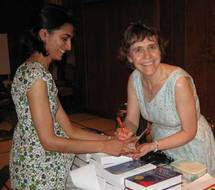
- Katherine Barber
- Canada's Word Lady, Katherine Barber is an expert on the English language and a frequent guest on radio and television. She was Editor-in-Chief of the Canadian Oxford Dictionary. Her witty and informative talks on the stories behind our words are very popular. Contact her at wordlady.barber@gmail.com to book her for speaking engagements; she can tailor her talks to almost any subject. She is also available as an expert witness for lawsuits.