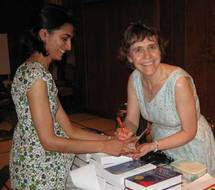
Welcome to the Wordlady blog!
This blog is about the fascinating, fun, and challenging things about the English language. I hope to entertain you and to help you with problems or just questions you might have with spelling and usage. I go beyond just stating what is right and what is wrong, and provide some history or some tips to help you remember. Is something puzzling you? Feel free to email me at wordlady.barber@gmail.com.
You can also order my best-selling books, Six Words You Never Knew Had Something to do With Pigs and Only in Canada You Say. Fun and informative!
Pages
Subscribe!
Subscribe! Fun facts about English delivered weekly right to your inbox. IT'S FREE! Fill in your email address below.
Privacy policy: we will not sell, rent, or give your name or address to anyone. You can unsubscribe at any point.
Search This Blog
Friday, November 16, 2018
Enter for a chance to win book about English idioms
Courtesy of Simon and Schuster Canada, Wordlady has two copies of Mark Abley's new book about English idioms, Watch Your Tongue to give away.
This book is available worldwide. Makes a great gift for the word lover on your list.
Currently available in bookstores, list price $29.99 Canadian.
amazon.ca
**CONTEST OPEN ONLY TO CANADIAN RESIDENTS**
To enter:
1) Subscribe to updates from
www.katherinebarber.blogspot.ca
(if you are not already subscribed)
For instructions on how to subscribe, click here
https://katherinebarber.blogspot.com/p/subscribe-by-email.html
2) Make sure you validate your subscription
3) send an email to wordlady.barber@gmail.com with the subject line ABLEY
If you are already a subscriber, go straight to step 3!
CONTEST CLOSES MIDNIGHT NOVEMBER 30
Phrases, idioms, and clichés—why do we say the things we say? Watch Your Tongue explores weird and wonderful everyday sayings and what they reveal about us.
Do you ever wonder why you shouldn’t have a cow but you should seize a bull by its horns? Who has the better reputation in language—cats or dogs? Do you sometimes feel that our speech is all smoke and mirrors or that our expressions simply make no sense?
In Watch Your Tongue, award-winning author Mark Abley explores the phrases, idioms, and clichés of our everyday language. With wit and subtle wisdom, he unravels the mysteries of these expressions, illuminating the history, tradition and stories behind everything we say. Pulling examples from Shakespeare’s plays to sports team names, ancient Rome to Twitter, Abley shares samples and anecdotes of the eccentric ways that we play with, parse, and pattern language.
Why do so many companies use fruit for their brand names? What do politicians mean when they say they’re going to “drain the swamp”? Why does English use chickens to signify cowardice? Abley dives into the history and psychology behind these examples and countless others, unpacking their significance (and sheer absurdity) to show how our language developed, where it is headed, and what we can learn about ourselves from it.
Whimsically illustrated, easily browsable, and full of catchy sidebars, Watch Your Tongue celebrates how we amuse ourselves with words and what our sayings reveal about the way we see the world.
Tuesday, September 18, 2018
Miniature
https://youtu.be/zHYlNNV-etQ
I've been enjoying watching The Miniaturist on PBS.
You might well think that "miniature" has something to do with "minimum" or "minute" (i.e. the "tiny" sense of "minute"). But you would be wrong.
The real story is much more surprising. The word comes from the Latin minium meaning "red lead", a bright red oxide of lead formerly used in artists' paints. In the Middle Ages, the scribes used this pigment in their illuminated manuscripts, especially for titles, headings, and initials.
In Italian, a verb, miniare, was derived from minium,meaning "illustrate a manuscript". A miniatura was an illumination in a manuscript, not just in red, but in any colour. Since these illuminations were of necessity very small, this Italian word, and its English derivative "miniature", came to mean any small picture. Subsequently it came to apply to other small-sized versions of larger things: dogs, marshmallows, chocolates, golf, what have you.
And then it generated the shortened form "mini-".
The title of this TV series is a bit of an anachronism for 17th-century Amsterdam, since "miniaturist" did not enter English till the 19th century, and was not used of dollhouse makers till the 1940s.
Now, what about the pronunciation of those first five letters?
MINN a?
MINNY a?
MINN ya?
It was almost certainly "MINNY a" to start with, but in Britain this has been gradually reduced to "MINNa".
In North America, "MINNY a" still exists, alongside "MINNa".
It would seem that in Canada, "MINNY a" and "MINN a" are almost neck and neck, with slightly more people saying "MINNY a". Some respondents reported that they switch between the two, sometimes randomly, sometimes depending on what the miniature thing is. Others felt they were influenced by knowing how it's pronounced in French. When we researched and edited the Canadian Oxford Dictionary, we put "MINN a" first and "MINNY a" second, but I rather suspect the situation was a similar close-run race to my most recent survey.
In the US, the situation is similar, but with slightly more people opting for "MINN a". This surprises me somewhat as Merriam-Webster lists "MINNY a" first (and the PBS voiceover person calls the show "The MINNY a turist").
I say "MINNAchur". I remember in my youth making fun of the Kraft ads on TV touting their latest vile jellied salad recipe which invariably included "MINNY a chur" marshmallows and what sounded like "Kraft horrible dressings" (it was in fact "pourable dressings"). Fear not, I have outgrown making fun of other people's pronunciations, and I certainly did not make fun of our invaluable pronunciation informants. Still not a fan of jellied salad though.
What do you say?
I've been enjoying watching The Miniaturist on PBS.
You might well think that "miniature" has something to do with "minimum" or "minute" (i.e. the "tiny" sense of "minute"). But you would be wrong.
The real story is much more surprising. The word comes from the Latin minium meaning "red lead", a bright red oxide of lead formerly used in artists' paints. In the Middle Ages, the scribes used this pigment in their illuminated manuscripts, especially for titles, headings, and initials.
In Italian, a verb, miniare, was derived from minium,meaning "illustrate a manuscript". A miniatura was an illumination in a manuscript, not just in red, but in any colour. Since these illuminations were of necessity very small, this Italian word, and its English derivative "miniature", came to mean any small picture. Subsequently it came to apply to other small-sized versions of larger things: dogs, marshmallows, chocolates, golf, what have you.
And then it generated the shortened form "mini-".
The title of this TV series is a bit of an anachronism for 17th-century Amsterdam, since "miniaturist" did not enter English till the 19th century, and was not used of dollhouse makers till the 1940s.
Now, what about the pronunciation of those first five letters?
MINN a?
MINNY a?
MINN ya?
It was almost certainly "MINNY a" to start with, but in Britain this has been gradually reduced to "MINNa".
In North America, "MINNY a" still exists, alongside "MINNa".
It would seem that in Canada, "MINNY a" and "MINN a" are almost neck and neck, with slightly more people saying "MINNY a". Some respondents reported that they switch between the two, sometimes randomly, sometimes depending on what the miniature thing is. Others felt they were influenced by knowing how it's pronounced in French. When we researched and edited the Canadian Oxford Dictionary, we put "MINN a" first and "MINNY a" second, but I rather suspect the situation was a similar close-run race to my most recent survey.
In the US, the situation is similar, but with slightly more people opting for "MINN a". This surprises me somewhat as Merriam-Webster lists "MINNY a" first (and the PBS voiceover person calls the show "The MINNY a turist").
I say "MINNAchur". I remember in my youth making fun of the Kraft ads on TV touting their latest vile jellied salad recipe which invariably included "MINNY a chur" marshmallows and what sounded like "Kraft horrible dressings" (it was in fact "pourable dressings"). Fear not, I have outgrown making fun of other people's pronunciations, and I certainly did not make fun of our invaluable pronunciation informants. Still not a fan of jellied salad though.
What do you say?
Sunday, August 12, 2018
How prepositions can make us sound like old fogeys
Are you enamoured / enamored of something?
Enamoured / enamored by something?
Enamoured / enamored with something?
How about enamoured / enamored on something?
What preposition is correct after "enamoured / enamored"?
I know, you thought, "Well, definitely NOT "on"!" You may be surprised to learn that for the first three centuries or so after we borrowed this word from French, we English speakers were enamoured on people. Then, starting in about 1600, we became enamoured of people, and also of things.
A much less frequent possibility was "enamoured with", so infrequent that the OED editors in 1891 declared it obsolete, although it wasn't. "Enamoured with" burbled along for a couple of centuries, but then starting in the 1970s, began to stage a come-from-behind win on "of". (Keep scrolling after the chart, there's more.)
In the NOW corpus (6 billion words of online newspaper and magazine text starting in 2010), "enamo(u)red with" (1973 instances when I did the search) has pulled clearly ahead of "enamo(u)red of" (1065 instances). This is confirmed by the Canadian Newsstream database of Canadian newspapers (2425 with vs 1166 of since 2010). Indeed, the late nineties seem to have been decisive in the onward march of with as you can see from this chart of yearly usages of "enamo(u)red with" in Canadian Newsstream starting in 1991.
We're not done yet with this preposition competition. Lurking on the horizon is "enamo(u)red by": 1289 instances on NOW, notably more than "enamo(u)red of", and 509 on Canadian Newsstream.
The Canadian Oxford Dictionary offers only "of" but if I were revising it today I would change that. Personally, I say "enamoured of" and there is certainly nothing wrong with that, but as time marches on I will probably start to sound like an old fogey. What am I saying, I probably already sound like an old fogey to Young People Today. At least I don't say "enamoured on"!
For another prepositional shift, and more evidence of the arbitrariness of prepositions, see This is exciting.
I will be offering my fun "Rollicking Story of English" course in downtown Toronto again this fall. Subscribe to Wordlady to make sure you can be first to sign up when I open registration in a couple of weeks.
To have fun facts about English delivered right to your inbox, click here to subscribe by email.
Privacy policy: we will not sell, rent, or give your name or address to anyone. You can unsubscribe at any point.
Tuesday, August 7, 2018
More about mauve
Last week's post about the pronunciation of "mauve" created quite a stir. I promised that I would tell you more about this word, and here we are.
We owe the popularity of "mauve" in English to a British chemist, William Henry Perkin (1838–1907). As a student at the ripe old age of 18, Perkin was given the task of chemically synthesizing quinine, which was much in demand as an anti-malaria medication and at the time had to be derived from the bark of the cinchona tree.
Tinkering around in his lab with coal-tar derivatives, Perkin created a substance which, as it turned out, was not quinine, and useless against malaria, but fantastic as a colourfast and fade-resistant rich purple colouring matter. He had stumbled upon the first synthetic dye.
Being a chemist and not a poet, Perkin called it "aniline purple", but he knew he was on to something. Previously, purple dyes had had to be obtained from a Mediterranean shellfish and were so expensive that only royalty wore purple clothes. Still only 19, Perkin plunged his father's life savings into a factory to produce his dye, which others started to call "Perkin's purple". But two years later, in 1859, the more chic-sounding "mauve", borrowed from French (always our go-to language for fashion), took over. I'm not sad about the demise of "Perkin's purple" because can you imagine having to say, "This year's fashion must-have is this lovely Perkin's purple purse." Mauve quickly became all the rage in the fashion industry and Perkin became a very wealthy man.
The French had been using mauve to designate a delicate purple colour since the beginning of the 19th century. It was in fact the name for this plant:
![]() |
| Malva sylvestris |
Mauve derived from the Latin name of the plant, malva. English had also borrowed this Latin word, as far back as Anglo-Saxon times, but in English it evolved into "mallow". (The Latin name was also revived in the Renaissance -- of course -- and is now commonly used by gardeners.)
One variety of mallow is the "marsh mallow"
The roots of this particular mallow yield a mucilaginous substance that has over the centuries been used in medicinal preparations. Starting in the 19th century, it was also used to give the distinctive texture to the pillowy confectionery item we like to put in our s'mores. Nowadays, gum arabic has replaced the actual marsh mallow, but the name has stuck.
And what is the French word for marshmallow? Guimauve!
For a flower that was even more successful in having a colour named after it, see pink.
For more plant- and gardening-related posts, click here.
S'mores photo by Jessica Ruscello on Unsplash
Tuesday, July 31, 2018
How do you pronounce "mauve"?
I was talking to an American friend a few weeks ago, when she uttered the word "mauve". It didn't rhyme with "stove" as it does for me and obviously, therefore, should do for all right-minded people.
The vowel in her "mauve" was what we would traditionally call a "short o", which you might transcribe variously (depending on your accent) as MAWV or MAHHV or MOV.
Although I wisely refrained from saying, "How odd that you don't know how to pronounce that. How idiosyncratic!", I have to admit I did think it. Not so fast, Wordlady. A few days later, another American said "mauve" the same way. Curiouser and curiouser.
It turns out that Americans have had this variant short-o pronunciation of "mauve" since sometime in the mid-20th century. In the 1934 second edition of Merriam-Webster's New International Dictionary of English, only MOHV was given. But in the third edition, published in 1961, the short-o pronunciation appeared, listed second (i.e. the less frequent of the two). Since then, though, this pronunciation has taken over as much the more common one in the US. It is now listed first in Merriam-Webster's online dictionary, and is the only one given when you click on the "hear this word pronounced" icon: https://www.merriam-webster.com/dictionary/mauve
In a recent survey I did of a group of editors, "short-o" outnumbered "long-o" by a factor of two to one among Americans. (I suppose some of them from the Eastern Seaboard with varieties of English in which "tauter" and "totter" are not homophones may have a third pronunciation, like "MORV" without the R.) One of them even said, "I giggle to think it could rhyme with stove!" Another said, "MOHV is only the pronunciation in French, not in English."
But only Americans have this second pronunciation. Canadians, despite living next door, and being subjected to American home decorating and fashion TV shows, only rhyme it with "stove", and this is also true of the rest of the English-speaking world. The results of my survey with Canadians were a whopping 245 to two in favour of "rhymes with stove". Many Canadians are, like me, stunned to learn that a different pronunciation even exists.
Some commentators, however, complain that the now more common US pronunciation is "wrong", because after all the word came from French (more about that next week) and we should pronounce it as the French do. But Lord knows we have borrowed many French words into English and given them non-French pronunciations. We now say "MARGE ah rin" and not "mar ga REEN" for "margarine", for instance. Whatever the majority of speakers say becomes a standard pronunciation.
(Don't get me started on people who pronounce "brioche" bree-OASH instead of bree-OSH though! Just kidding, but it does bug me in spite of myself.)
Quite frankly, I don't know where short-o "mauve" started out in the US, or why. We borrowed "mauve" into English from French in the mid-19th century, so it is not a case of a pre-colonization pronunciation surviving in the US and being replaced by something else in Britain. (For examples of that phenomenon, see clamber, process, lieutenant, height, primer, herb, ancillary.)
It's not that frequent a word, so it's entirely possible that most people encounter it first in writing, and therefore apply the phonetic rules of their native language to the foreign spelling. But why this phenomenon should have happened for "mauve" only in the US and not in the other English-speaking countries, even those that are less influenced by French than Canada is, is still a mystery.
The same vowel change has happened with earlier 19th- or 18th-century borrowings:
- the cooking use of "sauté", more commonly pronounced SAW tay than SO tay in both American and Canadian English, - though not the ballet term, which is only SO tay
- "vaudeville", by now pronounced almost exclusively VAWD vill
No one, to my knowledge, is suggesting that people should say "SO tay" or "VOH dvill" instead, but one never knows with language cranks.
But this vowel change has not happened (yet?) with more recent borrowings from the 20th century:
- "haute (cuisine etc.)" (mostly 20th century though some 19th)
- "fauve" (admittedly a specialist term)
- "taupe" (also a fairly specialist term except that it is used a lot as a colour designation for pantyhose)
- "auteur"(also a specialist term)
- "chauffeur"
There's a lot more to the story of mauve. What does it have to do with s'mores, for instance? Tune in next week for the continuation.
And don't forget to tell me: long o or short o, how do YOU pronounce "mauve"?
To have fun facts about English delivered right to your inbox, click here to subscribe by email.
Privacy policy: we will not sell, rent, or give your name or address to anyone. You can unsubscribe at any point.
Thursday, July 26, 2018
CSI: Spelling. What's wrong with rigour mortis?
![]() |
| Wait. Is that a.... spelling mistake? Why, yes, it is! |
I recently saw someone (no doubt a Canadian) write "rigour mortis" instead of the correct "rigor mortis".
I suspect a Canadian because we Canadians have a very strong tendency to write "-or" words as "-our" just to prove we're not American -- even when "-or" is the correct spelling. See these posts:
http://katherinebarber.blogspot.com/2016/06/canadian-hypercorrection.html
http://katherinebarber.blogspot.com/2013/11/stupor-or-stupour.html
and for the explanation of the :-or/-our" split, see this post:
http://katherinebarber.blogspot.com/2011/07/discouver-vancouver.html
"Rigour" derives ultimately from the Latin rigor (unbending quality, stiffness, rigidity), but it came into English in the 1400s by way of Middle French, where rigor had morphed into rigour. British English and other varieties of Commonwealth English retained this spelling, whereas American English opted for "rigor".
"Rigor mortis", on the other hand, was borrowed directly from Latin in the early 19th century. It retains its Latin spelling in all varieties of English.
And to make life more complicated, the adjective "rigorous" is also so spelled in all varieties of English.
To have fun facts about English delivered weekly right to your inbox, click here to subscribe by email.
Privacy policy: we will not sell, rent, or give your name or address to anyone. You can unsubscribe at any point.
Monday, July 16, 2018
Running the gambit, oops I mean gamut
I recently saw someone using the expression "running the gambit".
This is a mistake; the correct expression is "run the gamut".
GAMUT
But what is a gamut, anyway?
In French, the word for a musical scale is to this day gamme. Our first evidence of the word "scale" (derived from the Italian word scala, a ladder) in this sense comes from the Tudor composer Thomas Morley:
I always laugh when I consult musical entries in the Oxford English Dictionary and come across the title of this book. As one of my colleagues at the Canadian Oxford Dictionary liked to call it: "Thomas Morley's Renaissance Polyphony for Dummies".
Even though it lost out to "scale" in music, "gamut" survived in an extended figurative sense meaning "the entire range", and people have been "running the gamut" increasingly frequently since the early 19th century.
GAMBIT
"Gambit", on the other hand, is originally a chess term, designating a sequence of moves, involving a sacrifice to launch an attack or gain some other advantage.
The Oxford English Dictionary has this informative etymology, in which you can almost see the etymology editor puffing on a pipe reflectively between the two sentences:
PRONUNCIATION
For many years in my youth, when I was familiar with "run the gamut" only in writing, I pronounced "gamut" as "ga-MUTT". (Have you ever pronounced it this way, or is it just me?) It came as quite a shock when I realized that it is actually pronounced "GAMM utt" and that I was, gasp, wrong.
I still like "ga-MUTT" better, though. Perhaps it would save people from confusing it with "gambit".
Photo credit: JESHOOTS.COM
To have fun facts about English delivered weekly right to your inbox, click here to subscribe by email.
This is a mistake; the correct expression is "run the gamut".
GAMUT
But what is a gamut, anyway?
Back in the middle ages, a scale extending from low G of the modern bass clef to the upper E of the modern treble clef included all the notes generally used in medieval music. This low G was what we would call "do" of the scale, but the word "do" didn't exist at the time. "Ut" was the medieval equivalent of our "do". Like the other names of
the notes in our modern-day scale, it came from the initial syllable in a line of a hymn for St John the Baptist's day:
Ut queant laxisresonare fibrisMira gestorumfamuli tuorum,Solve pollutilabii reatum,Sancte Iohannes
So, to indicate that this low G was the tonic note, it was called "gamma-ut". This got squished together as "gamut" and also came to be used to designate the whole scale.
(Over
time, it became clear that "ut" was not a syllable that lent itself to
singing, so the Italians replaced it with "do" in the 1600s. "Si" became "ti" in the 19th century to avoid having two notes starting with S.)
In French, the word for a musical scale is to this day gamme. Our first evidence of the word "scale" (derived from the Italian word scala, a ladder) in this sense comes from the Tudor composer Thomas Morley:
1597 T. Morley A Plaine & Easie Introduction to Practicall Musicke 7 Phi. Why then was your Scale deuised of xx notes and no more? Ma. Because that compasse was the reach of most voyces: so that vnder Gam vt the voice seemed as a kinde of humming, and aboue E la a kinde of constrained shrieking.Constrained shrieking! I love it. (Sorry, sopranos.)
I always laugh when I consult musical entries in the Oxford English Dictionary and come across the title of this book. As one of my colleagues at the Canadian Oxford Dictionary liked to call it: "Thomas Morley's Renaissance Polyphony for Dummies".
Even though it lost out to "scale" in music, "gamut" survived in an extended figurative sense meaning "the entire range", and people have been "running the gamut" increasingly frequently since the early 19th century.
GAMBIT
"Gambit", on the other hand, is originally a chess term, designating a sequence of moves, involving a sacrifice to launch an attack or gain some other advantage.
The Oxford English Dictionary has this informative etymology, in which you can almost see the etymology editor puffing on a pipe reflectively between the two sentences:
Probably a borrowing from Spanish. Or perhaps a borrowing from Italian.That non-committal etymology editor does conclude that ultimately the word comes from 14th-century Italian gambetto (a tripping up in wrestling), from gamba (leg). The word came into English in the chess sense in the 1600s, and two hundred years later took on the meaning of a plan, stratagem, or ploy that is calculated to gain an advantage, especially at the outset of a contest, negotiation, etc.
PRONUNCIATION
For many years in my youth, when I was familiar with "run the gamut" only in writing, I pronounced "gamut" as "ga-MUTT". (Have you ever pronounced it this way, or is it just me?) It came as quite a shock when I realized that it is actually pronounced "GAMM utt" and that I was, gasp, wrong.
I still like "ga-MUTT" better, though. Perhaps it would save people from confusing it with "gambit".
Photo credit: JESHOOTS.COM
To have fun facts about English delivered weekly right to your inbox, click here to subscribe by email.
Subscribe to:
Posts (Atom)
About Me
- Katherine Barber
- Canada's Word Lady, Katherine Barber is an expert on the English language and a frequent guest on radio and television. She was Editor-in-Chief of the Canadian Oxford Dictionary. Her witty and informative talks on the stories behind our words are very popular. Contact her at wordlady.barber@gmail.com to book her for speaking engagements; she can tailor her talks to almost any subject. She is also available as an expert witness for lawsuits.