It is the season for people to throw themselves with much pomp into the state known as wedlock. The word has nothing to do with locks, despite its ending. Derived from the Old English word wed (pledge) and the suffix lac (the action of), it simply means “the act of pledging”. If the suffix lac is related to any other English word at all, it is to one meaning “play”, “fun”, and “glee”. No balls and chains!
Friday, June 15, 2012


Thursday, June 7, 2012
Descriptive vs. Prescriptive?
An interesting essay by Steven Pinker on the prescriptive/descriptive debate: http://www.slate.com/articles/arts/the_good_word/2012/05/steven_pinker_on_the_false_fronts_in_the_language_wars_.single.html
Monday, June 4, 2012
The Queen and Disco
What does this:

have to do with this:

and even this:

More than you would think! This week I have been asked to be the guest blogger at the Macmillan Dictionary blog, and you will find the answer (and some fascinating word histories!) there by clicking here.
have to do with this:
and even this:
More than you would think! This week I have been asked to be the guest blogger at the Macmillan Dictionary blog, and you will find the answer (and some fascinating word histories!) there by clicking here.
Friday, June 1, 2012
Paeans for peonies

One of the joys of June is the sight of a peony in profligate bloom. It is sure to make anyone feel better, and in fact peonies are named after the ancient Greek word for “doctor”, which came from the name of Paean, the physician of the gods. As time went on, Paean became identified with the god Apollo, to whom hymns of thanksgiving for victory in battle were sung. Since all these songs started with the invocation “O Paean!”, they became known as paeans, and eventually a paean became any expression of praise.
Learn more fascinating facts about the English language in my "Rollicking Story of English" course this fall. Registration is now open. More info here:
http://katherinebarber.blogspot.ca/p/history-of-english-language-courses.html
P.S.
If you find the English language fascinating, you might enjoy regular
updates about English usage and word origins from Wordlady. Receive
every new post delivered right to your inbox! If you have not already subscribe, you can either:
use
the subscribe window at the top of this page
OR
(if
you are reading this on a mobile device): send me an email with the
subject line SUBSCRIBE at wordlady.barber@gmail.com
Privacy
policy: we will not sell, rent, or give your name or address to
anyone. You can unsubscribe at any point.
Follow
me on twitter: @thewordlady
Friday, May 25, 2012
Ah-choo
The flowers that bloom in the spring lighten the hearts of many, but only clog up the nasal passages of others. The word “allergy” was coined in 1906 from the Greek word, allos (different) and the end of the word “energy”. But surely people had allergies before then? Indeed they did. An Italian doctor of the mid-1500s, observing the sneezing and itching suffered by a patient exposed to roses, dubbed the affliction “rose fever”. But in the 1820s we begin to see references to “hay asthma” or “hay fever”, the latter term becoming established when a physician in the mid-1800s fingered grass and other pollens as the culprit. He advised his patients to avoid it by spending the summer on a yacht. Try getting your health plan to cover that!
For the fascinating history of the word "sneeze", click here.
For the fascinating history of the word "sneeze", click here.
Friday, May 18, 2012
Rhubarb
In May, many of us have the very civilized pleasure of feasting on rhubarb harvested from our gardens. Since it first came into Europe by way of Russia, the Greeks called it rha, which may have been an old name for the Volga River. The Romans insisted even more on its foreignness by tacking on the adjective barbarum (foreign), derived from an imitative Greek word, barbaros (babbling). The ancient Greeks dismissed foreign languages as babbling, and thought anyone who didn't have the good fortune to be Greek was automatically uncivilized; this is why barbaros has also given us the word “barbarian”.
Friday, May 4, 2012
I could have danced all night
I'm just back from a wonderful week in Germany escorting a group of ballet lovers to see 21 ballets in 10 days. What better time to look at the word "dance". Surprisingly, its origins are somewhat obscure. It didn't show up in English until the 1200s, borrowed from the French, who seem (along with other Romance languages) to have borrowed it from an Old High German word dansôn (to stretch out). The sense ‘to form a file or chain in dancing’ is thought to have arisen from this.
But people had danced in Anglo-Saxon England before the French arrived, despite severe moral disapproval from the church and even attempts to ban dancing. For one thing, dancing had been used in pre-Christian fertility rites. What's more, dancing was associated in the Bible with Salome: clearly dancers had a propensity for demanding people's heads on a platter.

Clerics notwithstanding, the Anglo-Saxons carried on dancing, their word for it being tumbian. Like the Latin word for dance, saltare, it also meant "leap". Tumbian later acquired an -le ending (what linguists call a frequentative ending, which indicates frequent repetition or intensity) and became "tumble". Is it not interesting that a word that started out meaning "dance" ended up meaning "fall over"? We saw this with the word "trip" as well (click here). What does this say about the innate English ability to dance? Perhaps my tendency to fall over my feet in my ballet classes can be ascribed, not to any individual failing, but to an unavoidable genetic inheritance!
For the origin of some dance terms:
For "adage", click here.
For "entrechat", click here.
For "ballotté", click here.
For "fouetté", click here.
For "bourrée", click here.
For "pirouette", click here
If you're interested in travelling to see great dancing in beautiful places (no tripping, tumbling, or heads on platters, I promise), please check out my website at toursenlair.blogspot.com
But people had danced in Anglo-Saxon England before the French arrived, despite severe moral disapproval from the church and even attempts to ban dancing. For one thing, dancing had been used in pre-Christian fertility rites. What's more, dancing was associated in the Bible with Salome: clearly dancers had a propensity for demanding people's heads on a platter.

Never trust a dancer
Clerics notwithstanding, the Anglo-Saxons carried on dancing, their word for it being tumbian. Like the Latin word for dance, saltare, it also meant "leap". Tumbian later acquired an -le ending (what linguists call a frequentative ending, which indicates frequent repetition or intensity) and became "tumble". Is it not interesting that a word that started out meaning "dance" ended up meaning "fall over"? We saw this with the word "trip" as well (click here). What does this say about the innate English ability to dance? Perhaps my tendency to fall over my feet in my ballet classes can be ascribed, not to any individual failing, but to an unavoidable genetic inheritance!
For the origin of some dance terms:
For "adage", click here.
For "entrechat", click here.
For "ballotté", click here.
For "fouetté", click here.
For "bourrée", click here.
For "pirouette", click here
If you're interested in travelling to see great dancing in beautiful places (no tripping, tumbling, or heads on platters, I promise), please check out my website at toursenlair.blogspot.com
Subscribe to:
Posts (Atom)
About Me
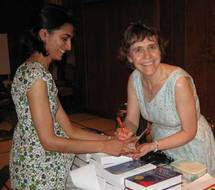
- Katherine Barber
- Canada's Word Lady, Katherine Barber is an expert on the English language and a frequent guest on radio and television. She was Editor-in-Chief of the Canadian Oxford Dictionary. Her witty and informative talks on the stories behind our words are very popular. Contact her at wordlady.barber@gmail.com to book her for speaking engagements; she can tailor her talks to almost any subject. She is also available as an expert witness for lawsuits.