Thursday, August 16, 2012
It ain't easy doing adagio
Over on my ballet website, I've started a weekly series on the history of some ballet terms. We start with "adagio", and how it is surprisingly related to the words "easy" and "adjacent". Please click here.


Friday, August 10, 2012
Of mice and men
With the Olympics monopolizing the airwaves for the last two weeks, a lot of muscle has been on display. But lest you think athletes have a monopoly on muscle, you might want to contemplate these pictures of ballet dancers. (You will probably want to contemplate them no matter what you think!)
 |
| Canadian dancer Matthew Golding of Dutch National Ballet photo credit: Erwin Olaf |
OK, class, stop drooling now, and apply your mind to more intellectual pursuits, to wit: the etymology of the word "muscle". (If you want to see Matthew's muscles in the flesh, you could always come with me on a ballet trip to Holland next May .)
"Muscle" ultimately derives from the Latin musculus (little mouse), mus meaning "mouse" and culus being a diminutive ending. The Romans saw a similarity in shape between muscles (especially the biceps) and mice (hey, this is an excuse for you to look at those pics again to check just how much those biceps look like mice). OK, are you back with me now? Another mouse-shaped thing also called a musculus was the bivalve mollusc Mytilus edulis, which you and I know as a ... mussel.
 |
| mussels: tasty, but less exciting than muscles |
"Mussel" came directly from Latin into Anglo-Saxon, much earlier than "muscle", which arrived in English via French in the 14th century. They both seem to have kept the "K" sound from the Latin origin (as indeed the French word muscle still does) through the 16th century, at which point the "MUSSLE" pronunciation won out. The spelling distinction, with "muscle" reserved for the body part and "mussel" for the shellfish, was not definitively established till the 19th century. It is not surprising that an anatomical term kept a silent letter reflecting the original Latin spelling of the word, while a food term did not, anatomy being the purview of learned folk while eating is for ordinary folk.
If all this leaves you wondering why the French word for "mouse" is souris instead of some derivative of the Latin mus, this is a typical case of Old French deriving its vocabulary from Popular Latin (i.e. Latin slang) rather than Classical Latin. In Popular Latin, the word for "mouse" was sorex, which in Classical Latin meant "shrew" (ie the rodent, not the ill-tempered woman).
Now, I don't want to leave you without giving you a chance to see those beautiful balletic muscles in action, so here you go. MUCH better than the Olympics!
If
you love ballet, please check out my season of outstanding ballet
trips in 2012-13 by clicking here.
Robert Tewsley and Julia Kraemer in the comic Le Grand Pas de Deux:
Friday, August 3, 2012
Casting dispersions
Reading a recent article in my local
newspaper, I stumbled on this malapropism:
"I cast no dispersions, but I know in my heart there's got to be a better way."
According to Google, this is a not uncommon mistake for "cast aspersions". "Aspersion" comes from the Latin word aspergere (sprinkle), and was first used of the act of sprinkling the faithful with holy water. But, who knows why, it almost immediately came to acquire the figurative sense of "damaging imputations or unjust insinuations", a rather genteel version of the image we get from the synonymous "mud-slinging".
In this case, I suspect the mistake was made by the reporter recounting the speaker's words rather than the speaker himself, because the article was rife with howlers:
Thanks to a misplaced modifier, Toronto police acquired an unusual new uniform and weapons:
"A patient walked out of Toronto East General Hospital and was later shot by police wearing a hospital gown and wielding scissors."
I guess budget cuts account for the fact that the police had only one hospital gown amongst them (and goodness knows they're hard enough to fasten up the back when there's only one body in them!) .
Apparently, the demands of the heart are such that hospitals need an alarm code to cover the eventuality of patients running off to get married:
"The most high profile incidents in the past year have been the two code yellows (the hospital code for a missing, wandering, or eloped patient)."
Did they really mean "eloped"? Perhaps there's some legal usage of the word I am not familiar with (if so I am sure an eager reader will let me know), although the only strictly legal definition the OED gives is the one it phrases so delightfully.
Mountains are to be found in hospital offices:
"a tour of the hospital Friday morning giving a peak inside the security office"
For the difference between "peak", "peek" and even "pique", see this post.
But I don't think the reporter can be blamed for this particular gem of bureaucratese:
"If there's a person in crisis that we believe less lethal support could be used."
I think this means "we probably shouldn't shoot mentally ill patients dead." It does rather suggest that the speaker thinks that such a thing as "lethal support" could exist, but there are less lethal options available. I tend to think of "lethal" (when being used literally) as absolute; something either kills you or it doesn't.
But perhaps I shouldn't cast dispersions on him for his language use.
"I cast no dispersions, but I know in my heart there's got to be a better way."
According to Google, this is a not uncommon mistake for "cast aspersions". "Aspersion" comes from the Latin word aspergere (sprinkle), and was first used of the act of sprinkling the faithful with holy water. But, who knows why, it almost immediately came to acquire the figurative sense of "damaging imputations or unjust insinuations", a rather genteel version of the image we get from the synonymous "mud-slinging".
In this case, I suspect the mistake was made by the reporter recounting the speaker's words rather than the speaker himself, because the article was rife with howlers:
Thanks to a misplaced modifier, Toronto police acquired an unusual new uniform and weapons:
"A patient walked out of Toronto East General Hospital and was later shot by police wearing a hospital gown and wielding scissors."
I guess budget cuts account for the fact that the police had only one hospital gown amongst them (and goodness knows they're hard enough to fasten up the back when there's only one body in them!) .
Apparently, the demands of the heart are such that hospitals need an alarm code to cover the eventuality of patients running off to get married:
"The most high profile incidents in the past year have been the two code yellows (the hospital code for a missing, wandering, or eloped patient)."
Did they really mean "eloped"? Perhaps there's some legal usage of the word I am not familiar with (if so I am sure an eager reader will let me know), although the only strictly legal definition the OED gives is the one it phrases so delightfully.
Of a wife: To run away from her husband in the company of a paramour.
I'm thinking that definition may be up for review when the lexicographers get to the letter E!
Mountains are to be found in hospital offices:
"a tour of the hospital Friday morning giving a peak inside the security office"
For the difference between "peak", "peek" and even "pique", see this post.
But I don't think the reporter can be blamed for this particular gem of bureaucratese:
"If there's a person in crisis that we believe less lethal support could be used."
I think this means "we probably shouldn't shoot mentally ill patients dead." It does rather suggest that the speaker thinks that such a thing as "lethal support" could exist, but there are less lethal options available. I tend to think of "lethal" (when being used literally) as absolute; something either kills you or it doesn't.
But perhaps I shouldn't cast dispersions on him for his language use.
Friday, July 27, 2012
Sport
In case you hadn't heard, the Olympic Games open today. Anyone looking at the Olympics realizes that sport is a very serious business indeed, but “sport” was originally the equivalent of “fun”, and didn't necessarily involve physical exertion. It was a shortened form of “disport” (a pastime), from the Latin dis (away) and portare (carry), the idea being that amusement carried one away from serious or sad occupations, in much the same way that a “diversion” is literally something that “turns you away” from other matters.
Friday, July 20, 2012
Tire
It's Tour de France season, and this week we heard of the misfortunes of the cyclists whose tires were punctured by tacks which someone had maliciously scattered across their route. Cyclists (yay us!) are, in fact, the people we have to thank for the nice air-filled shock-absorbing tires on our vehicles. Pneumatic tires were invented by Robert Thomson in 1845, but they didn't catch on because people preferred soid rubber tires, probably thinking they were more durable. But then cycling started to take off, and in 1888, John Dunlop, a Belfast veterinarian, revived the idea of air-filled rubber tires and patented them for bicycles. Then the Michelin company in France adapted pneumatic tires for cars in 1895 (hence the French word for "tire": pneu). It was about this time that the British opted for the spelling "tyre", while North Americans stuck with the older form "tire".
But tires of one sort or another have, surprisingly, been with us since the late 1400s. Back then what you got was a set of curved pieces of iron plate to cover your wooden carriage wheels. Not very shock-absorbing! The word was a shortening of "attire": tires were what you "clothed" your wheels with. "Attire" came from a French word, atirier (to arrange in a row, to put in order). It is related to our word "tier" as in "tiers of seats", and also, more surprisingly, to the word "artillery". The artillerie in 13th-century France was all of your weapons of war lined up in a row; it got narrowed down to cannon and guns in the 14th century.
The verb "tire" (fatigue) is a different word altogether, coming from Anglo-Saxon.
Friday, July 13, 2012
Superstition
Friday the 13th is a good day to look at the word "superstition". Back in the 1500s, English speakers liked to borrow words from Latin to sound learned, and because of the Protestant Reformation they were always on the lookout for ways to slag off the Catholic Church. With "superstition", they got a two-for-one deal. It is derived from the Latin word superstitiōnem, the noun of action derived from superstāre (to stand upon or over).
It is thought that the etymological meaning of this is ‘standing over a thing in amazement or awe’. When it was first used in English, it was with the sense "Unreasoning awe or fear of something unknown, mysterious, or imaginary, esp. in connection with religion; religious belief or practice founded upon fear or ignorance", and the quotations from the time will give you an idea of the tenor of the debate, if you could call it that:
.
It is thought that the etymological meaning of this is ‘standing over a thing in amazement or awe’. When it was first used in English, it was with the sense "Unreasoning awe or fear of something unknown, mysterious, or imaginary, esp. in connection with religion; religious belief or practice founded upon fear or ignorance", and the quotations from the time will give you an idea of the tenor of the debate, if you could call it that:
a1538 T. Starkey Dial. Pole & Lupset Their [the monks'] solitary life which hath brought forth with little profit to the public state, much superstycyon.
1547 J. Griffiths Two Bks. Homilies Other kinds of papistical superstitions‥as of Beads, of Lady Psalters and Rosaries.
1549 H. Latimer Serm. Ploughers Where the Devyll is residente‥up with all superstition and Idolatrie, sensing,‥holye water, and newe service of mens inventing.
This was obviously a much more loaded term than the one we use now for touching a rabbit's foot for good luck!
For an explanation of why we say "thirteenth" instead of "threeteenth", click here.
Friday, July 6, 2012
Is "ask" a noun?
A friend of mine mentioned to me recently that he had just heard the word "ask" used as a noun (a phenomenon he found distasteful). This usage is particularly popular amongst fundraisers, who butter up their prospects before going for the "ask" for money.
But should we object to the usage? And how new is it? Well, you may be shocked to learn that "ask" has been a noun for quite some time... a millennium, in fact! So we can't object to it on grounds of newness (even if that were a valid objection to usages, which it isn't).
Can we object to it on the grounds that verbs shouldn't be used as nouns? Well, only if you want, on the same grounds, to stop using nouns like "take" (as in "they counted the take"), "walk" and "run" ("go for a walk/run"), "stretch", "hold", and many other nouns that started out life as verbs. Words can shift their function, and there is no rule against this. In fact, it is one of the great flexibilities of language. For more on the reverse phenomenon, "nouns being used as verbs", please click here.
While we're on the subject of the word "ask", just how awful are those people who pronounce it "ax"?
In Old English, the word was áscian. This should have ended up as "ash" in modern English, following the same pattern that transformed Old English æsce into "ash" (the tree), and wæsc(e)an into "wash". But because metathesis (the inverting of the order of consonants) was quite common in Old English, an "aks" variant had arisen even before the Normans arrived, a form which survived down to nearly 1600 as the regular literary form. This still survives in some dialects of English, though supplanted in standard English by ask, originally the northern form. As with all such things, it is just an accident of history that we now use the "ask" form instead of the "ax" one.
For more on metathesis, click here.
P.S.
If you find the English language fascinating, you might enjoy regular
updates about English usage and word origins from Wordlady. Receive
every new post delivered right to your inbox! You can either:
use
the subscribe window at the top of this page
OR
(if
you are reading this on a mobile device): send me an email with the
subject line SUBSCRIBE at wordlady.barber@gmail.com
Privacy
policy: we will not sell, rent, or give your name or address to
anyone. You can unsubscribe at any point.
Follow
me on twitter: @thewordlady
Subscribe to:
Posts (Atom)
About Me
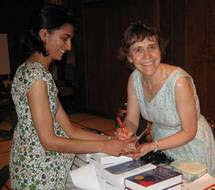
- Katherine Barber
- Canada's Word Lady, Katherine Barber is an expert on the English language and a frequent guest on radio and television. She was Editor-in-Chief of the Canadian Oxford Dictionary. Her witty and informative talks on the stories behind our words are very popular. Contact her at wordlady.barber@gmail.com to book her for speaking engagements; she can tailor her talks to almost any subject. She is also available as an expert witness for lawsuits.