Saturday, June 25, 2011
cravat
June 25 is Croatia's national holiday, known as “Statehood Day”. A good day to look at a word for a type of necktie. In the 17th century, Croatian mercenaries in the armies of other European countries wore neckcloths of lace or linen, tied in a bow with long flowing ends. This became all the rage in French fashion, for both men and women. It was named after its originators, called in their native language “Hrvati”. Since French-speakers could not pronounce “hrv”, the word became cravate, and subsequently “cravat” in English.


Should you hate the word "responsibilize"?
For some reason, the suffix -ize, which has been hugely productive in English for the last 600 years (the OED lists almosts 3000 words with this ending, with "canonize", "evangelize", "solemnize" and "authorize" dating from the 1300s), tends to raise some people's hackles.
"Jeopardize" was roundly attacked in the 19th century, but no one objects to it now, nor to "economize", "terrorize", "formalize", or any number of other -ize words which, at one point, were new coinages. Yet, when people encounter a new (to them) word with this suffix, some of them have hissy fits.
A friend of mine recently came across "responsibilize" in something she was editing and felt she should, in her words, "share this atrocity" with me. Why is "responsibilize" an "atrocity" whereas no one bats an eyelid at the similarly formed "mobilize" or "stabilize" (both borrowed from French in the 1800s)? French seems to have fewer qualms about words like this, living happily with "culpabiliser" (make someone feel guilty) and "sensibiliser" (make someone aware of or sensitive to) -- and expressing those ideas a lot more efficiently than English does, I must say! "Responsabiliser" has been used in French since the 1970s, as indeed "responsibilize" and its derivatives have been in English.
It seems that Spanish doesn't mind being creative with -ize endings either. I recently stumbled across this: "HERMAN CORNEJO PROTAGONIZARÁ EL CORSARIO". That is, Herman Cornejo will perform the lead role in Le Corsaire. But "protagonize" is so much more efficient!
"-ize" is an extraordinarily useful suffix. It dates back to the ancient Greeks, who used it to create words like "barbarize" (literally, "speak like a foreigner") and (it goes without saying the much more commendable) "Hellenize" (to be or speak like a Greek). As a (somewhat testy?) lexicographer at oxforddictionaries.com puts it: "Some traditionalists object to recent formations of this type: during the 20th century, objections were raised against prioritize, finalize, and hospitalize, among others. There doesn't seem to be any coherent reason for this, except that verbs formed from nouns tend, inexplicably, to be criticized as vulgar formations"
-ize doesn't deserve the opprobrium it gets. Just try living without it.
"Jeopardize" was roundly attacked in the 19th century, but no one objects to it now, nor to "economize", "terrorize", "formalize", or any number of other -ize words which, at one point, were new coinages. Yet, when people encounter a new (to them) word with this suffix, some of them have hissy fits.
A friend of mine recently came across "responsibilize" in something she was editing and felt she should, in her words, "share this atrocity" with me. Why is "responsibilize" an "atrocity" whereas no one bats an eyelid at the similarly formed "mobilize" or "stabilize" (both borrowed from French in the 1800s)? French seems to have fewer qualms about words like this, living happily with "culpabiliser" (make someone feel guilty) and "sensibiliser" (make someone aware of or sensitive to) -- and expressing those ideas a lot more efficiently than English does, I must say! "Responsabiliser" has been used in French since the 1970s, as indeed "responsibilize" and its derivatives have been in English.
It seems that Spanish doesn't mind being creative with -ize endings either. I recently stumbled across this: "HERMAN CORNEJO PROTAGONIZARÁ EL CORSARIO". That is, Herman Cornejo will perform the lead role in Le Corsaire. But "protagonize" is so much more efficient!
"-ize" is an extraordinarily useful suffix. It dates back to the ancient Greeks, who used it to create words like "barbarize" (literally, "speak like a foreigner") and (it goes without saying the much more commendable) "Hellenize" (to be or speak like a Greek). As a (somewhat testy?) lexicographer at oxforddictionaries.com puts it: "Some traditionalists object to recent formations of this type: during the 20th century, objections were raised against prioritize, finalize, and hospitalize, among others. There doesn't seem to be any coherent reason for this, except that verbs formed from nouns tend, inexplicably, to be criticized as vulgar formations"
-ize doesn't deserve the opprobrium it gets. Just try living without it.
Wednesday, June 22, 2011
The eyes have it
A very frequently misspelled word is ophthalmology, the branch of medicine dealing with the eyes (and its derivative ophthalmologist). Most commonly, people forget the first h, likely under the influence of "optic", but the first l also often falls by the wayside. If you have problems with this word (and who can blame you?), you have two options:
1) This word is about eyes, and we have two of those, so think about that to help you remember that there are two h's and two l's.
2) Use the word "eye doctor"! (if only life were so easy...)
1) This word is about eyes, and we have two of those, so think about that to help you remember that there are two h's and two l's.
2) Use the word "eye doctor"! (if only life were so easy...)
Friday, June 17, 2011
Word of the week: confetti
Wedding season is in full swing, so let us look at the word “confetti”, derived from the Latin confectus (prepared, pickled), which also gave us the old-fashioned English word “comfit” (a candy). In fact, in Italian, confetti means “candies”, specifically those sugar-coated almonds that are given away at christenings and weddings. Italians threw these – or plaster imitations of them – during carnival, at parades. The custom spread to southern France, where people started using paper as a cheaper (not to mention less painful) projectile. The English adopted the custom and the word, which became a singular noun for us only in the 20th century.
Monday, June 13, 2011
When REALLY not to use "u" after "q"
The capital of one of Canada's northern Territories, Nunavut, goes by the euphonious name Iqaluit (it used to be called Frobisher Bay, much less musical). In Inuktitut, Iqaluit means "many fish". Unfortunately English spelling has a habit of putting a "u" after the letter "q", so English speakers commonly misspell Iqaluit as Iqualuit (in fact I just saw that spelling in yesterday's Ottawa Citizen). Indeed, in September 2009 the Prime Minister's Office used this misspelling repeatedly in a press release, causing a great brouhaha when the Nunavut Language Commissioner pointed out that "iqualuit" means "people with large unwiped bums" (that's bums in the "buttocks" sense, for any American readers who are confused). DEFINITELY a mistake you don't want to make.
Another Inuktitut borrowing into English with a "q" not followed by "u" is qiviut, or the fine underbelly hair of a muskox. There's a bit of trivia to impress your friends with.
Another Inuktitut borrowing into English with a "q" not followed by "u" is qiviut, or the fine underbelly hair of a muskox. There's a bit of trivia to impress your friends with.
Friday, June 10, 2011
Why isn't life a bowlful of cherrieses?
What a treat it is to see Ontario cherries come into season. “Cherry” comes from a Latin word, ceresea, which became the French word cerise (in Northern French dialect cherise). Why is there an s on the end in French but not in English? In fact, there used to be an s in English as well. You would have one cherise and many cherises (because who can stop at just one?). But this was too much for English-speakers, for whom an s ending suggested a plural, so they dropped the s in the singular and made it “cherry”.
For the story of another word that underwent a similar evolution, click here to read about "skate".
For the story of another word that underwent a similar evolution, click here to read about "skate".
Friday, June 3, 2011
links
With the return of the nice weather, many of you will be hitting the links. Golf links have no connection with the word “link” meaning “connect”. “Links” comes from an Old English word, hlinc (rising ground or a ridge). The word died out in southern England but survived in Scotland to designate gently rolling sandy ground covered with grass near the seashore. These were probably the original golf courses.
Subscribe to:
Posts (Atom)
About Me
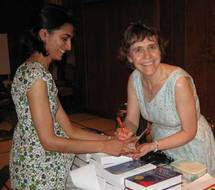
- Katherine Barber
- Canada's Word Lady, Katherine Barber is an expert on the English language and a frequent guest on radio and television. She was Editor-in-Chief of the Canadian Oxford Dictionary. Her witty and informative talks on the stories behind our words are very popular. Contact her at wordlady.barber@gmail.com to book her for speaking engagements; she can tailor her talks to almost any subject. She is also available as an expert witness for lawsuits.