Just a reminder that I am teaching a fun History of the Language course at the School of Continuing Studies starting September 13 for 8 weeks. You can still register by following this link; .
2414 History of the English Language
Did you know that the word "travel" is derived from an instrument of torture? That "tragedy" originally had something to do with goats? That hotels and hospitals have something in common? The fascinating history of the English language is full of such surprises. This course is a survey of the influences that have shaped English vocabulary over the years, covering the Anglo-Saxon and Viking origins, the influx of Norman French and Central French, later Latin and Greek borrowings, standardization and French borrowing in the 18th century, and international borrowing since the 18th century. We will tie linguistic developments in with the social and political events with which they coincided. Topics will include why English spelling is so difficult, why we have such a large wordstock, and how dictionaries are written.
Saturday, September 4, 2010


Federal judge strikes blow for lexical reference books!
A convict's desire to own a thesaurus is taken to court and upheld against wardens who deemed it wasn't "educational".
http://www.thestar.com/news/canada/article/856608--humpty-dumpty-takes-fall-in-b-c-court-ruling-on-thesaurus
http://www.thestar.com/news/canada/article/856608--humpty-dumpty-takes-fall-in-b-c-court-ruling-on-thesaurus
I wish....
Just stumbled across this statement in a Calgary Herald article from earlier this year:
Since it first appeared in 1998, more than a million copies of the Canadian Oxford Dictionary have been sold. And Katherine Barber, who supervised its production and that of the 2005 second edition, has become a minor celeb as "Canada's Word Lady."
A million copies! Wow! So how come I don't have a job anymore???
(Actually I think that figure is, shall we say, somewhat exaggerated).
Since it first appeared in 1998, more than a million copies of the Canadian Oxford Dictionary have been sold. And Katherine Barber, who supervised its production and that of the 2005 second edition, has become a minor celeb as "Canada's Word Lady."
A million copies! Wow! So how come I don't have a job anymore???
(Actually I think that figure is, shall we say, somewhat exaggerated).
Tweeting about bunnyhugs?
This article in the Toronto Star suggests that regionalisms such as "bunnyhug" (Saskatchewanian for "hoodie") might spread thanks to Twitter and Facebook. I want "jambuster" (Manitoban for "jelly doughnut") to take over the world! Get to it, you Manitobans!
All the same, I wonder how much people actually talk about their hooded sweatshirts and doughnuts on Twitter or Facebook.
All the same, I wonder how much people actually talk about their hooded sweatshirts and doughnuts on Twitter or Facebook.
Friday, September 3, 2010
Word of the Week: pilot
Pilots will be showing off this weekend at Toronto's annual air show. To designate someone in charge of a boat, the English had been quite happy with the Anglo-Saxon word “steersman” till the mid-1400s. Why they decided they needed to replace it with a nifty new French word, “pilot”, we don't know. The French word came via Latin from the Greek pedota, from pedon (an oar or rudder). Since there were no aircraft, “pilot” was originally confined to people steering boats, but in the 19th century we see pilots in hot-air balloons, and just two years after the Wright brothers made their first flight in 1905, the word was being used of fliers.
Wednesday, September 1, 2010
No flora in your lightbulbs or toothpaste
Two related words which are very commonly misspelled are "fluorescent" and "fluoride". Don't forget the "U". Fluorescence and fluoride have nothing to do with flowers. They're derived from a mineral, fluor, called that because it is easily melted and thus fluid.
P.S.
If you find the English language fascinating, you might enjoy regular
updates about English usage and word origins from Wordlady. Receive
every new post delivered right to your inbox! If you are not already
subscribed, you can either:
use
the subscribe window at the top of this page
OR
(if
you are reading this on a mobile device): send me an email with the
subject line SUBSCRIBE at wordlady.barber@gmail.com
Privacy
policy: we will not sell, rent, or give your name or address to
anyone. You can unsubscribe at any point.
Also
check out my upcoming
Rollicking Story of the English Language courses.
Follow
me on twitter: @thewordlady
What century are they living in?
I was reading an online ballet magazine today which had a post, written this week, in which I was astounded to see that the writer wrote about "taking a 'bus" and "talking on the 'phone". Considering that the word "phone" has been used to mean "telephone" since 1880, a mere 4 years after Alexander Graham Bell first wrote about his invention, I think we can happily say that we don't need the apostrophe anymore.
"'Bus" is an even more glaring example of pretentious punctuation. We have evidence of "bus" as a short form for "omnibus" back to 1832, only three years after the first evidence of "omnibus" itself, which is so dead in the English language that surely no one needs to think that they have to memorialize that missing "omni" with an apostrophe. People, buy yourselves a dictionary published in the last decade!
"'Bus" is an even more glaring example of pretentious punctuation. We have evidence of "bus" as a short form for "omnibus" back to 1832, only three years after the first evidence of "omnibus" itself, which is so dead in the English language that surely no one needs to think that they have to memorialize that missing "omni" with an apostrophe. People, buy yourselves a dictionary published in the last decade!
Subscribe to:
Posts (Atom)
About Me
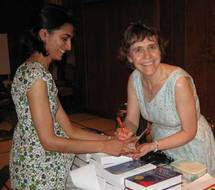
- Katherine Barber
- Canada's Word Lady, Katherine Barber is an expert on the English language and a frequent guest on radio and television. She was Editor-in-Chief of the Canadian Oxford Dictionary. Her witty and informative talks on the stories behind our words are very popular. Contact her at wordlady.barber@gmail.com to book her for speaking engagements; she can tailor her talks to almost any subject. She is also available as an expert witness for lawsuits.