Welcome to the Wordlady blog!

This blog is about the fascinating, fun, and challenging things about the English language. I hope to entertain you and to help you with problems or just questions you might have with spelling and usage. I go beyond just stating what is right and what is wrong, and provide some history or some tips to help you remember. Is something puzzling you? Feel free to email me at wordlady.barber@gmail.com.
You can also order my best-selling books, Six Words You Never Knew Had Something to do With Pigs and Only in Canada You Say. Fun and informative!

Subscribe!

Subscribe! Fun facts about English delivered weekly right to your inbox. IT'S FREE! Fill in your email address below.
Privacy policy: we will not sell, rent, or give your name or address to anyone. You can unsubscribe at any point.

Search This Blog

Friday, June 19, 2015

This one's got me beaten

I was brought up short by this sentence in a Toronto Star article:
"Kate Cayley has beat out established writers including Margaret Atwood to win the 2015 Trillium Book Award worth $20,000."

"That should be beaten!" I harumphed schoolmarmishly.

But then the thought occurred to me (this rarely happens) that I might be (gasp) WRONG.

It's always a good idea to check some dictionaries before making a pronouncement.  Most dictionaries give only "beaten" as the past participle of "beat", but Merriam-Webster's Collegiate and the Oxford English Dictionary acknowledge the existence of a past participle "beat". OED points out that, although "has beat" has been in use in all of the many senses of this verb since the Middle Ages, it most commonly occurs in the meaning "overcome, defeat, surpass".

Looking at some corpus databases of American English text, I discover that "has beaten" (in all senses) is now about 10 times as common as "has beat", but historically it was only about 5 times as common. So "has beat" may well be on its way out, but it's not quite dead yet. 

The participial "beat" is firmly established in colloquial phrases like "It can't be beat" or "you've got me beat", and in the adjective "beat-up".

What is the past participle of "beat" for you? If you saw a participial "beat", would you automatically "correct" it to "beaten"?  Would you call a dilapidated jalopy a "beat-up old car" or a "beaten-up old car"?


P.S. If you find the English language fascinating, you might enjoy regular updates about English usage and word origins from Wordlady. Receive every new post delivered right to your inbox! If you are not already subscribed, you can either:

use the subscribe window at the top of this page
OR
(if you are reading this on a mobile device): send me an email with the subject line SUBSCRIBE at wordlady.barber@gmail.com

Privacy policy: we will not sell, rent, or give your name or address to anyone. You can unsubscribe at any point.

Follow me on twitter: @thewordlady


Friday, June 5, 2015

How do you say "primer"?


A correspondent has inquired about the pronunciation of the word "primer" in the "introductory textbook" sense. 

He noticed that it is often pronounced (or, in his view, mispronounced) "primmer" on the CBC, and feels that this "new" pronunciation is an error introduced by American influence and mindlessly perpetuated by Canadians.

He will no doubt be surprised to learn that nothing could be further from the truth.

"Primmer" is the original pronunciation, and much older than "pry-mer", which seems to date only from the 19th century, likely under the influence of both the spelling, once mass literacy became established, and of the "paint" homonym. There are reasons having to do with the Great Vowel Shift which account for the difference in vowel between "prime" and "primer", but you're probably sick of the GVS by now so I will spare you the details.

As we have seen before with many British/North American differences, older pronunciations and usages brought over here when the first English settlers arrived have often survived on this side of the pond, whereas they have subsequently been corrupted by the British (see this post about herb/erb  and this one about height/heighth, for instance). I use the word "corrupt" in the dispassionate linguistic sense of "change" (but also because I like to provoke people!).

The Oxford English Dictionary notes that both pronunciations are in use on both sides of the Atlantic, though "pry-mer" is more common in Britain and "primmer" in the US. The Canadian Oxford also includes both pronunciations, with "pry-mer" first. But my father, for one, pronounced it "primmer".

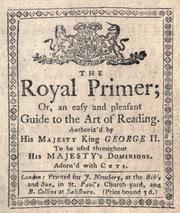
"Primer" in this sense has quite an interesting history. It comes from a medieval Latin word primarium (a prayer book for lay people).  These were often used to teach children how to read, and these "primers" soon became so associated with children's learning that the "first reader" connotations took over from the "prayerbook" connotations of the word. Even after prayers were removed altogether, the word "primer" was still applied to elementary reading books.

I don't think we use "primer" anymore for first readers. It sounds very one-room-schoolhouse to me. But I was surprised to see the types of books that are called primers in this day and age:


A Programmer's Guide to Java SE 8 Certification: A Comprehensive Primer
 

Multivariate Statistical Methods: A Primer

Feminist Legal Theory (Second Edition): A Primer

Neuropsychological Evaluation of Medically Unexplained Symptoms: Assessment Primer


In fact, primers nowadays seem still to be introductory textbooks, but usually of very advanced, highly technical subject matter. We've come a long way from


Would you use the word "primer"? And if so, how would you pronounce it?


P.S. If you find the English language fascinating, you might enjoy regular updates about English usage and word origins from Wordlady. Receive every new post delivered right to your inbox! If you are not already subscribed, you can either:

use the subscribe window at the top of this page
OR
(if you are reading this on a mobile device): send me an email with the subject line SUBSCRIBE at wordlady.barber@gmail.com

Privacy policy: we will not sell, rent, or give your name or address to anyone. You can unsubscribe at any point.

Follow me on twitter: @thewordlady


Monday, June 1, 2015

Lack, lock, or luck?


http://upload.wikimedia.org/wikipedia/commons/8/8d/Lilac-flowers1.jpg 

My lilac hedge is currently a plethora of pungent petals. Which leads me to wonder...

How is "lilac" pronounced anyway?

The Canadian Oxford Dictionary offers three possibilities, from most frequent to least: 
LIE l'k
LIE lock
LIE lack

Although I know we did a pronunciation survey for this, I still find it hard to believe that people really say LIE lack (I use the first pronunciation)

But Merriam-Webster has the same three pronunciations, in this order:

LIE lock
LIE lack
LIE l'k

So clearly we didn't make "LIE lack" up.

British dictionaries have only

LIE l'k

So what gives? 

Lilacs were introduced into European gardens in the late 1500s. Their ultimate origin was the Ottoman Empire, and before landing in England, the word had travelled the following lengthy route:
< French lilac, < Spanish lilac, < Arabic līlāk, apparently < Persian līlak, variant of nīlak bluish, < Persian nīl blue, indigo 

Notice that the French word back then was also lilac, though today it is lilas with the final consonant silent.  The early French spelling suggests that the pronunciation then in French was "leelack", and indeed our first English spellings also suggest this: 
1625   Bacon Essays 269   The Lelacke Tree.
1650   Surv. Nonsuch Palace, Archæol. V. 434   A fountaine of white marble..set round with six trees called lelack trees.
 
Since the 1600s saw substantial migration from Britain to North America, it is entirely possible that this older pronunciation came over at that time and stuck (to a certain degree), whereas in the motherland, it was gradually abandoned in favour of something else. 
 
By the 1700s we see spellings like "laylock", suggesting that CanOD's second-favourite pronunciation was beginning to take hold. By the mid-1800s, the spelling "lilac" had pretty much taken over, and it is impossible to deduce the pronunciation, though one has to assume that the British English tendency to reduce unstressed vowels to an indeterminate schwa was working its magic to turn "lielock" into "liel'k". 
 
Meanwhile, however, 19th-century American prescriptive pronunciation guides were insisting on "lielack", and there are still reports in the US of people on both sides of the lilac hedge being very judgemental about those who pronounce the shrub's name differently than they do. 

I wish people would spend their time and energy on something more useful, like smelling some lilacs and being thankful they exist.
 
The lilac's botanical name, Syringa (that's the uncontested "si RING ga" in case you were wondering), comes from the Greek word syrinx (pipe), because the tree's stems were easily hollowed out to be used for pipe stems. Indeed, another name for the lilac in the 1600s and 1700s was "pipe tree".
 
How do YOU pronounce "lilac"? Let me know!
 
And here's the Lilac Fairy (the symbol of goodness and wisdom) from Dresden Semperoper Ballet's Sleeping Beauty. If you would like to see it (and a lot of other great ballet) live in beautiful Dresden, why not check out my ballet trip to Berlin and Dresden next April. More info here: 


P.S. If you find the English language fascinating, you might enjoy regular updates about English usage and word origins from Wordlady. Receive every new post delivered right to your inbox! If you have not already subscribe, you can either:

use the subscribe window at the top of this page
OR
(if you are reading this on a mobile device): send me an email with the subject line SUBSCRIBE at wordlady.barber@gmail.com

Privacy policy: we will not sell, rent, or give your name or address to anyone. You can unsubscribe at any point.

Follow me on twitter: @thewordlady


Wednesday, May 27, 2015

It drives me mad

With the recent release of a new film version of Thomas Hardy's Far from the Madding Crowd, many people once again have the opportunity to get the title wrong and call it Far from the Maddening Crowd.

Hardy's title is an ironic allusion to Thomas Gray's Elegy in a Country Churchyard, published in 1751, in which the  poet refers to those buried there and their humble rural life:
Far from the madding crowd's ignoble strife,
Their sober wishes never learned to stray;
Along the cool sequestered vale of life
They kept the noiseless tenor of their way.
Although Hardy's novel does take place in rural Dorset, the passions which tear the characters apart make their life anything but a cool sequestered vale.

But why did Gray use "madding" rather than "maddening" in the first place? 

"Madding" is in fact an earlier word than "maddening". It meant both "becoming mad; acting madly; frenzied" and "driving mad", though it is the first sense that Gray was using in his poem.  "Madding" was derived quite regularly from a verb that used to exist, "to mad", meaning "to be or to become mad; to act like a madman, rage, behave furiously." This in turn was quite normally derived from the adjective "mad" (yes, really, it's ok to turn an adjective into a noun, see this post: http://blog.oxforddictionaries.com/2013/11/whats-wrong-with-this-verb/)

This verb had its day from the mid 1300s to the early 1800s, and then was replaced in both senses by its much younger (dating from the mid 1700s) offspring, "madden". For some reason, "madden" ceased to be used in the "go mad" sense early in the 20th century, leaving us, surprisingly, without a handy one-word verb for this sense. 

I have fond memories of being taken to see the 1967 movie of Far From the Madding Crowd starring Julie Christie and Alan Bates, which I just recently learned comes in at just under 3 hours in length.  I am amazed that my parents thought, "Hey let's take the kids to a 3-hour-long adaptation of a Victorian novel about the destructive nature of passion; they'll love it!" But we did love it, and I went home and read the book! I was 9 years old. (Much later, I called one of my cats "Bathsheba".) The moral of the story is: don't expose your children to Thomas Hardy at an early age.

They may become lexicographers.

https://youtu.be/DGgqRsXm73U


On a completely unrelated topic, if you are interested in Jewish contributions to ballet, please check out my lecture series starting June 1: 
http://toursenlair.blogspot.ca/2015/05/new-lecture-series-jewish-contributions.html


P.S. If you find the English language fascinating, you might enjoy regular updates about English usage and word origins from Wordlady. Receive every new post delivered right to your inbox! You can either:

use the subscribe window at the top of this page
OR
(if you are reading this on a mobile device): send me an email with the subject line SUBSCRIBE at wordlady.barber@gmail.com

Privacy policy: we will not sell, rent, or give your name or address to anyone. You can unsubscribe at any point.

Follow me on twitter: @thewordlady


Sunday, May 17, 2015

In (a) shambles

Well, I'd better post something before you all get concerned about what has happened to me. I know you have probably been spending every waking moment thinking, "Where's Wordlady? I'm worried! Maybe her life is in a shambles, and that's why she's not posting anymore."

Or would you say, "Her life is in shambles"?

And anyway, where does the word "shamble(s)" come from, and what is/are it/they?

I had cause to think about this on reading something described as being "in shambles", the same sort of construction as "in ruins" or "in tatters". Being the dispassionate descriptivist that I am, my immediate reaction was, "Well, that's just WRONG! It should be 'in A shambles'."

But then, being the dispassionate descriptivist that I am, I thought I'd better look into it before making any intemperate pronouncements.

"Shambles" has a long history, dating all the way back to the Latin word scamellum, a diminutive of scamnum (bench). This was borrowed into the Germanic languages even before the Anglo-Saxons set sail for Britain in the 5th century. A "scammel" (pronounced "shammle") was a stool, and subsequently a shop counter. 

By the 14th century, now spelled "shammel" to reflect its pronunciation, the word was being applied specifically to a market stall for selling meat or fish.  Since markets usually have several of these in one place, the plural form started to refer to a meat market: "a shammels". 

The shambles in the city of York
About the same time, the intrusive "b" found its way into the word, to make the phonetic transition from "m" to "l" easier. This phenomenon also happened with the words "crumble", "nimble", "thimble", "bramble", "mumble", and others.

By the 1500s, a "shambles" was a slaughterhouse, and not long after that, we see the word being used figuratively to mean "a place of carnage":  

The First World War, creating a pressing need for synonyms for "bloodbath", gave new life to the figurative use of the word. Descriptions of battle scenes inevitably included connotations of general disorder, and by the early twenties, "shambles" started to be used of scenes of chaos and devastation, whether or not carnage was involved. There was some criticism of this weakening of the word at the time, but as always, usage wins out, so that "disorder" is now the dominant, and perhaps only sense of the word.

Since, as we have seen before, English speakers just don't like singular words ending in -s, "in shambles" has also overtaken "in a shambles", as you can see (keep scrolling after the chart):
https://books.google.com/ngrams/graph?content=was+in+shambles%2Cwas+in+a+shambles&year_start=1920&year_end=2008&corpus=15&smoothing=3&share=&direct_url=t1%3B%2Cwas%20in%20shambles%3B%2Cc0%3B.t1%3B%2Cwas%20in%20a%20shambles%3B%2Cc0


So I should just get over my objection, and accept that saying "in shambles" is just as legitimate as "in a shambles", which is, in fact, the loser in this competition. What do YOU say? Please let me know.

Although the "disorder" sense of "shambles" was a North American development, the British have taken things one step further, creating the adjective "shambolic" sometime in the sixties. It surprises me that this has not yet really caught on this side of the Atlantic.

By the way, no need to worry about the state of my life. I've just been off escorting ballet lovers to Austria, the Czech Republic, Germany, and New York.

My life is not in a shambles. (There, you see, I just cannot bring myself to say "in shambles".)

Unfortunately, the same cannot be said for the state of my housekeeping.


P.S. If you find the English language fascinating, you might enjoy regular updates about English usage and word origins from Wordlady. Receive every new post delivered right to your inbox! You can either:

use the subscribe window at the top of this page
OR
(if you are reading this on a mobile device): send me an email with the subject line SUBSCRIBE at wordlady.barber@gmail.com

Privacy policy: we will not sell, rent, or give your name or address to anyone. You can unsubscribe at any point.

Follow me on twitter: @thewordlady


Wednesday, May 13, 2015

Find Out What Your Name Would be if You Were Born Today

As you know by now, I really like onomastics, and so I'm sharing this fun quiz for you. Apparently I just missed being "Paulette".

http://time.com/3856405/baby-name-popularity/?xid=fbshare

P.S. If you find the English language fascinating, you might enjoy regular updates about English usage and word origins from Wordlady. Receive every new post delivered right to your inbox! You can either:

use the subscribe window at the top of this page
OR
(if you are reading this on a mobile device): send me an email with the subject line SUBSCRIBE at wordlady.barber@gmail.com

Privacy policy: we will not sell, rent, or give your name or address to anyone. You can unsubscribe at any point.

Follow me on twitter: @thewordlady


About Me

My photo
Canada's Word Lady, Katherine Barber is an expert on the English language and a frequent guest on radio and television. She was Editor-in-Chief of the Canadian Oxford Dictionary. Her witty and informative talks on the stories behind our words are very popular. Contact her at wordlady.barber@gmail.com to book her for speaking engagements; she can tailor her talks to almost any subject. She is also available as an expert witness for lawsuits.