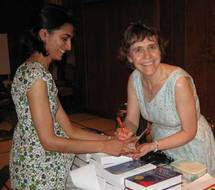
Welcome to the Wordlady blog!

This blog is about the fascinating, fun, and challenging things about the English language. I hope to entertain you and to help you with problems or just questions you might have with spelling and usage. I go beyond just stating what is right and what is wrong, and provide some history or some tips to help you remember. Is something puzzling you? Feel free to email me at wordlady.barber@gmail.com.
You can also order my best-selling books, Six Words You Never Knew Had Something to do With Pigs and Only in Canada You Say. Fun and informative!

Subscribe!

Subscribe! Fun facts about English delivered weekly right to your inbox. IT'S FREE! Fill in your email address below.
Privacy policy: we will not sell, rent, or give your name or address to anyone. You can unsubscribe at any point.

Search This Blog

Friday, July 30, 2010

Things they never told you in Girl Guide camp

If you're camping over the long weekend, you're probably grateful your tent is nylon rather than heavy canvas as they used to be. Besides, canvas (you'll be surprised to learn) is related to marijuana! The name derives from the Latin cannabis, because canvas was originally made from hemp. And why is “canvass” used for conducting a survey or door-to-door selling? In the 1500s, people were tossed about in canvases either for fun or as punishment (I'm not making this up). From there it was a short step for “canvassing” to mean the tossing about of an idea: soliciting opinions... or sales.

P.S. If you find the English language fascinating, you might enjoy regular updates about English usage and word origins from Wordlady. Receive every new post delivered right to your inbox! If you are not already subscribed, you can either:

use the subscribe window at the top of this page
OR
(if you are reading this on a mobile device): send me an email with the subject line SUBSCRIBE at wordlady.barber@gmail.com

Privacy policy: we will not sell, rent, or give your name or address to anyone. You can unsubscribe at any point.


Follow me on twitter: @thewordlady


Wednesday, July 28, 2010

Black Swan

Being a passionate ballet lover (if you are too, visit my other blog at toursenlair.blogspot.com), I was intrigued to come across what is apparently a trendy new term: "Black Swan event":

"A Black Swan is a highly improbable event with three principal characteristics: It is unpredictable; it carries a massive impact; and, after the fact, we concoct an explanation that makes it appear less random."

The Black Swan's author Nassim Nicholas Taleb states that Google and the September 11 attacks were Black Swans. Taleb also tells us "Black Swans underlie almost everything about our world, from the rise of religions to events in our personal lives".

However, apparently Taleb was not alluding to nasty Odile who turns up in Act III of Swan Lake and deceives the prince into thinking she's the good white swan Odette, but rather to the unexpected discovery of black swans which destroyed the theory that all swans are white.

Saturday, July 24, 2010

Now I'M tempted to ask WTF?

Further to my previous post, I am now surprised to discover a ballet program at the Royal Danish Ballet called
Who the f..#%&! is Nijinsky ...?
Things become even more surprising when one reads the blurb:
What are idols – and why do we need them? And who are Lady Gaga and the Laudrup brothers from the perspective of the dance world? That’s the theme of the new children’s and youth production created by Kompagni B. The company’s dancers participate in both the choreography and staging of this production, which is realized in partnership with selected school classes. Kompagni B is the world’s first professional children’s company associated with a ballet school and is comprised of students from grades 7 to 9. Children are in focus with Kompagni B, where the show is made for children, by children.

For children, by children? Somehow I can't imagine the staid Ontario school system supporting something with this title. Maybe it's less shocking in Danish?

Friday, July 23, 2010

Eponymous

The Toronto Star website has this puzzling summary of my article (next post) about canapés:
Canapés: a summer treat, a summer scourge

The eponymous finger food snack comes from the greek word for mosquito netting.

I hope the lack of a capital on "Greek" was just an oversight. But what on earth do they think "eponymous" means? "Boycott" is an eponymous word, originating in the name of a Mr. Boycott. If I were to release a CD of me singing (not a hot seller, I'm thinking!) called simply "Katherine", you could call that an eponymous CD. Or if I were to dance the lead role in the ballet Manon (that would be a dream come true for me, if not for the ballet audience, and certainly not for whatever unfortunate guy got to partner me), you could call me the eponymous heroine. But I can't see by any stretch how "eponymous" works in the context above.

Of Mosquitoes and Melba toast

A summer evening... a glass of wine … some canapés to snack on... Little do you suspect that those appetizers have something to do with the very same mosquitoes you're swatting. In Greek, a couch with mosquito netting was a konopeion (from konops, a gnat or mosquito). Focusing on the netting, we English derived the word “canopy” for a suspended piece of fabric. But the French focused on the couch itself, so their word canapé means “sofa”. Someone saw a resemblance between a person reclining on a couch and a shrimp perched on Melba toast, and thus hors d'oeuvres became “canapés”.

P.S. If you find the English language fascinating, you might enjoy regular updates about English usage and word origins from Wordlady. Receive every new post delivered right to your inbox! If you are not already subscribed, you can either:

use the subscribe window at the top of this page
OR
(if you are reading this on a mobile device): send me an email with the subject line SUBSCRIBE at wordlady.barber@gmail.com

Privacy policy: we will not sell, rent, or give your name or address to anyone. You can unsubscribe at any point.


Follow me on twitter: @thewordlady


Foot to foot resuscitation

Just came across the delightful term "foot to foot" to describe the way in which ballet, which notoriously lacks a universally acknowledged form of written notation analogous to musical scores, is traditionally transmitted from one generation to the next, from a dancer who learned the ballet himself or herself and then coaches the next performer, and so on down the line over the years. It's the balletic equivalent of oral history, with many of the same issues, especially when it comes to attempts to revive an "authentic" version of the original ballet.
For more on this topic, head over to my other blog at Tours en l'air Ballet Holidays

Thursday, July 22, 2010

Twinterns

I just saw the following job posting:

Job Description

Bunchland, a family culture e-zine reaching 10,000 influencer parents twice weekly, is hiring a twintern. WTF is a twintern? It’s an intern whose sole responsibility is to man our Twitter account. Read: You’ll tweet for us. All day. You will share relevant links and have conversations with our 3,500+ followers. If we like you, we’ll let you hang out with our 750+ Facebook fans as well.

I find this interesting from a number of points of view.

First of all, the word twintern, which as far as I can determine is about a year old, possibly invented by Pizza Hut. ("Influencer" might strike you as new, but according to the OED has been around since 1664, though perhaps not as a modifier.)

But I really find intriguing the use of WTF in a job posting.

It's not just the use of a text messaging abbreviation, as clearly this ad is trying to be self-consciously hip and is, after all, about the "Twitterverse".

Perhaps the job applicants will get extra points for writing sentences in their cover letters like this:
"OMG, I am so wanting this job. TTYL."

But it's the casual use of a profanity (even an abbreviated one, but everyone knows what that "F" stands for) that strikes me as truly remarkable.

About Me

My photo
Canada's Word Lady, Katherine Barber is an expert on the English language and a frequent guest on radio and television. She was Editor-in-Chief of the Canadian Oxford Dictionary. Her witty and informative talks on the stories behind our words are very popular. Contact her at wordlady.barber@gmail.com to book her for speaking engagements; she can tailor her talks to almost any subject. She is also available as an expert witness for lawsuits.