MacMillan Dictionaries has created this fun quiz on my favourite subject, functional shifts, better known as "Is it OK to use a noun as a verb or a verb as a noun?" The answer is YES, by the way. You can read my thoughts about it here:
http://katherinebarber.blogspot.ca/2010/09/verbs-its-ok-to-do-this-really.html
For many other examples that I've written about, you can click on the "nouns as verbs" tag.
Here's the quiz:
http://www.macmillandictionaryblog.com/nounings-and-verbings-quiz
I
don't think the point of the quiz is to see how many you get "right",
actually. I think it is to show how very embedded these conversions have
become in English, so we no longer have any notion that "Well, that's
really a NOUN; it shouldn't be used as a verb". Or vice versa.
Oh, and by the way, if you're tempted to quote Calvin and Hobbes "Verbing weirds language" as someone always does when this topic comes up, please don't. Verbing enriches the language, and it's perfectly normal. Not weird at all.
Showing posts with label conversion. Show all posts
Showing posts with label conversion. Show all posts
Thursday, February 8, 2018


Tuesday, December 12, 2017
How do you pronounce "grimace"?
 |
Several others chimed in that this was clearly wrong. Everyone knows it's pronounced "GRIM us".
I thought so too, but it's always best to check before making pronunciation pronouncements. Lo! It appears that "GRIM us" is an upstart. A hundred years ago, "grim ACE" was the only pronunciation for this word.
Before that, when we first borrowed the noun in the 1600s from the French grimace, we pronounced it a la francaise "gree MASS". By the time we turned the noun into a verb in the 1700s, it was being pronounced "gree MACE".
It is not uncommon for the stress in English to migrate from the second syllable to the first, leaving the vowel in the second, unstressed syllable to be reduced to a schwa. This is clearly what happened, though it is hard to say when exactly in the 20th century this came about.
One thing is for sure, when we surveyed Canadians about their pronunciation of "grimace" for the Canadian Oxford Dictionary, no one said "grim ACE", so we included only the "GRIM us" pronunciation. Other dictionaries, however, give "GRIM us" first and "grim ACE" second.
There are two theories as to the ultimate origin of "grimace":
- Middle French, alteration of grimache, of Germanic origin; akin to Old English grīma mask
- Spanish grimazo caricature, from grima fright.
I'm offering my Rollicking Story of the English Language course again in the New Year! More info here:
http://katherinebarber.blogspot.ca/2017/12/rollicking-story-of-english-course.html
Photo credit: Tom Roberts on Unsplash
Wednesday, February 22, 2017
This post has been thoroughly vetted
https://youtu.be/ZpCl5O6tTv8
There is much talk in the news these days of the "vetting" of refugee claimants.
Does this have anything to do with that friendly medical professional that Minkus and Papagena so love to visit?
Surprisingly, yes. The word "veterinarian" (derived from Latin veterīnus: belonging or pertaining to cattle) came into English in the 1600s, when we LOVED borrowing Latin words. Admittedly it's a mouthful, and by the mid-1800s it was shortened to "vet".
A few decades later, the inevitable had happened: the noun became a verb, "To submit (an animal) to examination or treatment by a veterinary surgeon":
The other "vet" was shortened from "veteran", also in the mid-1800s. "Veteran", which we borrowed from French in the early 1500s, ultimately comes from the Latin word vetus (old).
To search the archives of this blog,
click here, then replace the word "search" in the search window with the term you are looking for.
To have fun facts about English delivered weekly right to your inbox, click here to subscribe by email.
There is much talk in the news these days of the "vetting" of refugee claimants.
Does this have anything to do with that friendly medical professional that Minkus and Papagena so love to visit?
Surprisingly, yes. The word "veterinarian" (derived from Latin veterīnus: belonging or pertaining to cattle) came into English in the 1600s, when we LOVED borrowing Latin words. Admittedly it's a mouthful, and by the mid-1800s it was shortened to "vet".
A few decades later, the inevitable had happened: the noun became a verb, "To submit (an animal) to examination or treatment by a veterinary surgeon":
Of the 73 stallions..only 39 came back for a second inspection after they had been ‘vetted’Almost at the same time, in slang, the verb took on an extended sense: "make a careful and critical examination of (a plan, work, candidate, etc.)." By the 1950s, this sense had moved from slang to the neutral register of the language.
The other "vet" was shortened from "veteran", also in the mid-1800s. "Veteran", which we borrowed from French in the early 1500s, ultimately comes from the Latin word vetus (old).
To search the archives of this blog,
click here, then replace the word "search" in the search window with the term you are looking for.
To have fun facts about English delivered weekly right to your inbox, click here to subscribe by email.
Thursday, February 16, 2017
The dossier on "dossier"
 |
| A thick dossier |
This week, according to Merriam-Webster dictionaries,
Lookups for 'dossier' spiked after the news that U.S. investigators had confirmed portions of a dossier on Trump's ties to RussiaWhy do we call a collection of documents about a person or event this?
The French dossier comes from the word for "back" (dos); a bundle of documents on a particular subject was called this because it had a label on the back. We borrowed "dossier" in the mid-19th century, although we had the perfectly good "file" already (more about that later). Of course English has never been reluctant to acquire more synonyms for words it already has.
The early quotation that Merriam-Webster gives is
I may, however, mention from high legal authority, that the President laboured under a mistake when he demanded the displacement or even communication of the “dossiers” (legal papers) of the Boulogne and Strasburg affairs.Various criminal cases in French-speaking jurisdictions were reported on in English newspapers, and the Dreyfus affair at the end of the 19th century gave the word a bit of a bump in English as journalists reported on the scandal. Perhaps the fact that French was the language of diplomacy contributed to the word being borrowed in government circles.
—Freeman’s Journal (Dublin, Ireland), 11 Jan. 1849
DOSSY-ay or DOSSY-ur?
It seems that "dossier" first entered English through print rather than speech, because the OED's entry, written in 1897, gives as its first pronunciation not the French "doe SYAY", but rather the anglicized "DOSSY uh". But, while a very few people still do say this (or its r-ful North American variant, "DOSSY ur"), with English speakers becoming more familiar with French, we have, over time, ended up with a hybrid English/French pronunciation: "DOSSY ay" is now overwhelmingly most common in all varieties of English. A very small number of anglophones do, however, pronounce this word "DOE see ay".
FILE
Now, what about file? (Thank GOD everyone pronounces it the same!)
In Latin, the word fīlum meant "thread". This came into Old French as fil (pronounced "FEEL"), and it means "thread" to this day in French (as well as "wire" and other extensions of meaning).
But English went a different way with "fil" after we borrowed it from French in about 1500, using it for a very specific kind of thread: a string or wire on which papers and documents were strung for safekeeping and reference. From there it was just a short step for "file" to refer to the papers themselves, and then to other methods of keeping and organizing them, until in the 21st century our "files" are made of electrons.
A CANADIANISM!
Here in Canada we have our very own extension of the word "file":
- 4. Cdn issues and responsibilities in a specified area, considered collectively: what progress has the prime minister made on the unity file?
Oddly enough, this is a context where other varieties of the language might use the word ... "dossier"! In fact, I suspect that this is a usage that arose as a loan translation of the French dossier in Canada's bilingual federal public service.
OTHER FILES
And of course, all of these "files" have, quite naturally, generated verbs. Yes, more of those. No sign of "dossier" being used as a verb yet, but it's a fairly new word in English so it may be only a matter of time.
Meanwhile, please do not consign this blog post to the "circular file" (a term celebrating its 50th birthday in 2017)!
To search the archives of this blog,
click here, then replace the word "search" in the search window with the term you are looking for.
To have fun facts about English delivered weekly right to your inbox, click here to subscribe by email.
Check out my fun History of the English language course here
Wednesday, November 30, 2016
Whistling an unhappy tune
![Dog Whistle Politics: How Coded Racial Appeals Have Reinvented Racism and Wrecked the Middle Class by [Lopez, Ian Haney]](https://images-na.ssl-images-amazon.com/images/I/4163s0-ml2L.jpg)
In the last couple of years, we have, alas, become very familiar with the use of "dog-whistle" (usually as an adjective), meaning, to quote the OED:
2. Polit. A statement or expression which in addition to its ostensible meaning has a further interpretation or connotation intended to be understood only by a specific target audience.
In particular, it usually applies to words having a hidden meaning that only the bigoted hear.
Baltimore Sun editor John McIntyre also uses it in the following way:
“Dog whistle editing” is attention to distinctions of usage that only other copy editors can hear.You can see below, in a graph tracking the use of "dog-whistle" in Canadian newspapers, how much the usage has exploded, especially as a result of the US election campaign. We have "dog-whistle rhetoric", "dog-whistle campaigns", "dog-whistle racism", and above all, "dog-whistle politics".
Perhaps the most notorious of these wastes of time and attention is the over/more than distinction, observed only by American newspaper editors. Seriously. When I’ve mentioned this quibble to lexicographers, they’ve given me blank looks, over having been in use in the sense of more than since before the Normans corrupted Anglo-Saxon.

The inevitable has also happened: "dog-whistle" is now also used as a verb:
"And I think that was a disturbing trend in American politics, that this man was dog-whistling to some pretty disturbing elements"
Where did it all start?
A Canadian connection?
It seems, according to the OED, that there is a Canadian twist to this tale. The first evidence the dictionary has for it is from an article by Canadian journalist Jim Coyle about the then Conservative government in Ontario:
1995 Ottawa Citizen 15 Oct. a9/1 On the lips of Premier Mike Harris, the term ‘special interest’ has the tone of epithet. It's an all-purpose dog-whistle that those fed up with feminists, minorities, the undeserving poor hear loud and clear.However, Mr Coyle tells me that he cannot claim credit for this coinage, as "blowing the dog whistle" was a term much in use amongst reporters at the Ontario legislature already in the early eighties, to designate slyly-worded statements from politicians aimed at fanning anti-francophone sentiment.
Be that as it may, I have been unable to find any earlier written evidence in several large databases, so Mr Coyle may still hold the title of being the first to have committed this to paper. It is entirely possible that the Queen's Park reporters were the first to use the phrase. This decade-long lag between a word or phrase appearing in speech and its first written evidence is not uncommon. It is a phenomenon that underscores the unlikelihood that Shakespeare actually "invented" all the words for which the first written evidence is in his works.
Want to know more about why the English language is the (weird) way it is? Let me know if you would be interested in taking my very popular "Rollicking Story of the English Language" course in Toronto on a weekday afternoon (or possibly a Saturday or Sunday morning) in January, February, or March. Email me at wordlady.barber@gmail.com
ALSO! "Hebrew and Yiddish Words in English" on a weekday afternoon.
To search the archives of this blog,
click here, then replace the word "search" in the search window with the term you are looking for.
To have fun facts about English delivered weekly right to your inbox, click here to subscribe by email.
Wednesday, October 5, 2016
Sprucing up the place
 |
| Sprucing up the house |
Writing to a friend who was painting his flat this week, I referred to him "sprucing up" the place.
And then I thought, "Why do we say that? Does it have anything to do with conifers? Surely not! It must be just a coincidence, like pining for the fjords (click here for more on "pining")."
Well, I was WRONG. AGAIN! Sheesh!
Admittedly, though, the connection is very tenuous, but it led me to some interesting discoveries about the word "spruce" in all its usages.
Back in the 1300s and 1400s, the part of Europe bordering the southeastern coast of the Baltic Sea, inhabited by an ancient Baltic people called "Prussi" by the Romans, went by the name "Pruce" in English. After the Renaissance, when we preferred Latin names, we came to call it "Prussia".
But before that happened, "Pruce" had a variant name: "Spruce". Goods imported from or flora and fauna native to "Spruce" were naturally called "Spruce fish", "Spruce duck", and so on. A particularly valued commodity was the wood of a tall, straight coniferous tree that grew in the region and hence was called a "Spruce tree" or "Spruce fir". After a couple of centuries, we called it simply a "spruce".
But what does this have to do with sprucing oneself up?
Another valued commodity from "Spruce" was leather. In the 1400s and 1500s a "spruce leather jerkin" seems to have been a hot fashion item. If you wore one, you were considered pretty natty. And so "spruce" came to be treated as an adjective meaning "well dressed, dapper" or "well maintained; having a tidy appearance". At the same time, "spruce (up)" started to be used as a verb. (Find out whether it's ok to use an adjective as a verb here: http://blog.oxforddictionaries.com/2013/11/whats-wrong-with-this-verb/)
Here in Canada we have, by a scientific estimate, bajillions of spruces. More spruces than any other kind of tree. I like to think that if history had been different, they would be called "canadians", and the expression meaning "improve one's appearance" would be "to canadian oneself up". Maybe it's not too late...
PLEASE, if you liked this post, SHARE it.
Attention ballet lovers! I'm offering a new mini ballet appreciation course in November: More than the Hora: Jewish Contributions to Ballet. Of interest to all ballet lovers and all who are interested in Jewish culture and history. More info here:
http://toursenlair.blogspot.ca/2016/10/new-ballet-course-jewish-contributions.html
P.S. If you find the English language fascinating, you might enjoy regular updates about English usage and word origins from Wordlady. Receive every new post delivered right to your inbox! SUBSCRIPTION IS FREE! You can either:
use the subscribe window at the top of this page
OR
(if you are reading this on a mobile device): send me an email with the subject line SUBSCRIBE at wordlady.barber@gmail.com
Privacy policy: we will not sell, rent, or give your name or address to anyone. You can unsubscribe at any point.
Sunday, August 28, 2016
Going through a phase
 |
| Wait, is this a phaser or a fazer? |
- But nothing fazes Richard, so he'll be up for it.
- But nothing phases Richard, so he'll be up for it.
The word meaning "disconcert, trouble" has nothing to do with "phase". FAZE is a very old word, derived from Old English fésian (to drive away), which by the 15th century was also being used to mean "frighten, alarm". Like so many words that have died out of Standard British English, this one survived in North America, and by the 1830s had taken on the meaning "disconcert, disturb". It was subsequently revived in British English.
The homophone PHASE comes ultimately from the Greek word designating each of the aspects of the moon or a planet, according to the amount of its illumination. It is a mere stripling compared to "faze", having entered English in the 17th century. Very quickly its use was extended from the strictly astronomical sense to mean "a distinct period or stage in a process of change or development".
And then, GUESS WHAT??? It BECAME A VERB.
First, in the early 1900s, in electrical engineering:
To adjust the phase of (an oscillation, alternating current, etc.), esp. in order to bring it into phase or synchrony with something else.
and then, in the late 1940s, more generally:
To organize, carry out, or introduce in phases. Freq. with in (or out): to introduce into (or withdraw from) use, operation, etc., gradually or in stages.Remarkably, people were unfazed by this function shift. As they should be.
COMING THIS FALL! My ever-popular Rollicking Story of the English Language course. REGISTRATION NOW OPEN AND SPACE IS LIMITED. More info here: http://katherinebarber.blogspot.ca/p/history-of-english-language-courses.html
Would you enjoy talking about words with Wordlady over many, many glasses of wine? Why not check out my trip to Bordeaux and Toulouse in July 2017. Unlike most of my Tours en l'air trips, this is more about food, wine, and sightseeing than about ballet (though there is some of that too). BOOKING NOW, SIGNUP DEADLINE SEPTEMBER 20. More info here:
http://toursenlair.blogspot.ca/2016/08/toulouse-bordeaux-ballet-trip-july-2017.html
P.S. If you find the English language fascinating, you might enjoy regular updates about English usage and word origins from Wordlady. Receive every new post delivered right to your inbox! SUBSCRIPTION IS FREE! You can either:
use the subscribe window at the top of this page
OR
(if you are reading this on a mobile device): send me an email with the subject line SUBSCRIBE at wordlady.barber@gmail.com
Privacy policy: we will not sell, rent, or give your name or address to anyone. You can unsubscribe at any point.
Friday, February 20, 2015
How do you pronounce "schedule"?
SKED or SHED? The pronunciation of the word "schedule" is something that provokes quite virulent debate, with some members of each camp feeling that only theirs is "correct". Why people get so dogmatic about these things, I don't know.
So what's the scoop (or is it the shoop)?
The word came into English legal and official language from French in the 1300s, at which time it was written "sedule" or "cedule" (plus other variants) and meant "a slip of paper containing writing". The first syllable was pronounced the only way it could be pronounced: "SED". In modern French cédule is still pronounced this way, and most European languages other than English followed suit, adapting for their own particular phonology (s, ch, ts...), with no intrusive k sound:
Provençal cedula, cedola
Spanish cédula
Portuguese cedula
Italian cedola
German Zettel
Dutch cedel
Swedish sedel
Danish seddel
Why did we English speakers mess things up? French had acquired this word, like most of its vocabulary, from Latin, and this was the root of the problem. In Latin, the word was scedula (in medieval and modern Latin also written schedula), a diminutive of Latin sceda (medieval Latin also scheda), a page or a strip of papyrus. This was probably a back-formation from schedium (an impromptu speech) in turn derived from Greek schedios (casual);. In Latin, the first syllable was pronounced SKAYD. But in the passage from Latin to French, the "K" sound had fallen out of the word.
As regular Wordlady readers know, Latin messed up our spelling big time the 16th century. Scholars of the time looked at the original Latin and Greek words from which many English words were ultimately derived and said, "Hey! We should spell our English words like that too [so that people will know I'm really smart and know Latin]!". So, sensible old "sedule" had to be changed to "scedule" or the even more popular "schedule". People still pronounced it "sedule", though (much as we still pronounce "debt" as "det" despite that interloping Latin "b"), until well into the 19th century.
This is the point at which the SHED/SKED schism (SHIZZM? SIZZM? SKIZZM?) took place. Noah Webster convinced his American compatriots that the pronunciation should reflect the Greek origin of the word, and follow the example of similarly Greek-derived "school" and "scheme". In Britain, however, the SED pronunciation morphed into a SHED.
We Canadians? Of COURSE we have to have both pronunciations. When we surveyed people for the Canadian Oxford Dictionary on this question, we found that more Canadians said "SKED" than "SHED", but that both pronunciations exist. The "SHED" crew tend to think that the "SKED" lot are traitors to Canadian nationality, having adopted an American pronunciation. This is quite a ridiculous attitude to take, as we don't feel the same way about the vast majority of Canadians who say "toMAYto" like Americans rather than "toMAHto" like the British. I say "SHED", by the way, but am unperturbed by those who say "SKED".
The now most common meaning of "schedule", a timetable, is a fairly recent development, dating only from the mid-19th century in the US. From being an official piece of paper in the Middle Ages, "schedule" came to apply to tabular listings of figures (which is why we have "schedules" to attach to our income tax returns). With the coming of the railways, it was a handy word to use for tabular timetables.
Another thing that happened to "schedule" in the 19th century as a result of the railways was that it started to be used (here comes my hobbyhorse) as ... gasp... a verb. Noun-verb conversions, what would we do without them? Indeed, having now finished writing this, I am moving my cursor over to ... schedule it for publication.
So what's the scoop (or is it the shoop)?
The word came into English legal and official language from French in the 1300s, at which time it was written "sedule" or "cedule" (plus other variants) and meant "a slip of paper containing writing". The first syllable was pronounced the only way it could be pronounced: "SED". In modern French cédule is still pronounced this way, and most European languages other than English followed suit, adapting for their own particular phonology (s, ch, ts...), with no intrusive k sound:
Provençal cedula, cedola
Spanish cédula
Portuguese cedula
Italian cedola
German Zettel
Dutch cedel
Swedish sedel
Danish seddel
Why did we English speakers mess things up? French had acquired this word, like most of its vocabulary, from Latin, and this was the root of the problem. In Latin, the word was scedula (in medieval and modern Latin also written schedula), a diminutive of Latin sceda (medieval Latin also scheda), a page or a strip of papyrus. This was probably a back-formation from schedium (an impromptu speech) in turn derived from Greek schedios (casual);. In Latin, the first syllable was pronounced SKAYD. But in the passage from Latin to French, the "K" sound had fallen out of the word.
As regular Wordlady readers know, Latin messed up our spelling big time the 16th century. Scholars of the time looked at the original Latin and Greek words from which many English words were ultimately derived and said, "Hey! We should spell our English words like that too [so that people will know I'm really smart and know Latin]!". So, sensible old "sedule" had to be changed to "scedule" or the even more popular "schedule". People still pronounced it "sedule", though (much as we still pronounce "debt" as "det" despite that interloping Latin "b"), until well into the 19th century.
This is the point at which the SHED/SKED schism (SHIZZM? SIZZM? SKIZZM?) took place. Noah Webster convinced his American compatriots that the pronunciation should reflect the Greek origin of the word, and follow the example of similarly Greek-derived "school" and "scheme". In Britain, however, the SED pronunciation morphed into a SHED.
We Canadians? Of COURSE we have to have both pronunciations. When we surveyed people for the Canadian Oxford Dictionary on this question, we found that more Canadians said "SKED" than "SHED", but that both pronunciations exist. The "SHED" crew tend to think that the "SKED" lot are traitors to Canadian nationality, having adopted an American pronunciation. This is quite a ridiculous attitude to take, as we don't feel the same way about the vast majority of Canadians who say "toMAYto" like Americans rather than "toMAHto" like the British. I say "SHED", by the way, but am unperturbed by those who say "SKED".
The now most common meaning of "schedule", a timetable, is a fairly recent development, dating only from the mid-19th century in the US. From being an official piece of paper in the Middle Ages, "schedule" came to apply to tabular listings of figures (which is why we have "schedules" to attach to our income tax returns). With the coming of the railways, it was a handy word to use for tabular timetables.
Another thing that happened to "schedule" in the 19th century as a result of the railways was that it started to be used (here comes my hobbyhorse) as ... gasp... a verb. Noun-verb conversions, what would we do without them? Indeed, having now finished writing this, I am moving my cursor over to ... schedule it for publication.
P.S.
If you find the English language fascinating, you might enjoy regular
updates about English usage and word origins from Wordlady. Receive
every new post delivered right to your inbox! You can either:
use
the subscribe window at the top of this page
OR
(if
you are reading this on a mobile device): send me an email with the
subject line SUBSCRIBE at wordlady.barber@gmail.com
Privacy
policy: we will not sell, rent, or give your name or address to
anyone. You can unsubscribe at any point.
Follow
me on twitter: @thewordlady
Saturday, November 1, 2014
Voting or polling?
After our recent municipal elections, a friend posted this picture to facebook,
 |
| Photo: Gael Spivak |
It's "polling" that's the issue. Since the word "poll" took on the meaning "conduct an opinion survey" in the early 20th century, that has become by far its most common meaning. The "record votes in an election" sense has been replaced altogether, surviving only in these compounds, "polling station" and "polling place". So there is an argument to be made that "polling station" is now misleading, or at least not helpful, especially in a society like Canada's where English is a second language for many.
"Voting place" seems to be catching on in official communications from the elections authorites (though Elections Canada still seems to prefer "polling station"). However, in newspapers, the favoured word is still overwhelmingly "polling station", by a factor of 10 to 1.
Here in Toronto, whatever we call our venues, our signs went for a very efficient, space-saving, bald command (or maybe, in view of the ghastly four years of municipal politics we've just endured, it was a plea?):

I wonder if anyone has done a study on whether a verb lures more people to vote than a noun does. I know there have been studies showing that using the word "please" persuades people to act, so maybe in future our signs should say "Please vote here".
Where did "poll" and "vote" come from?
"Poll" arose in the 13th century, possibly borrowed from Dutch pol (top, summit), and originally meant "the part of the head on which the hair grows, the top of the head". It soon came to be used as a verb meaning "shave the hair on the head" and, after a couple of centuries, this verb was being used to mean "establish a head count" (a much more recent expression dating from the early 1900s). By the 1600s, "poll" was being used to mean "count votes" and, later "cast or record a vote".
"Vote" comes from the Latin vōtum (vow, wish), a past participle of vovēre (to vow, desire). Like many words borrowed from Latin, it came into English at the Renaissance, but was used only by the Scots until the 17th century.
So, if it hadn't been for the Scots, those Toronto signs would say "POLL HERE".
Friday, June 6, 2014
A word you never suspected had something to do with poets
Here in Canada we have an annual poetry award, the Griffin Prize. The prize for 2014 was announced last night, so in honour of poetry we are going to look at a word you never suspected had something to do with poets: scold.
Scold comes from skald, a Viking word for an ancient Scandinavian poet. Goodness knows what Viking poets were like, because the word subsequently came to mean "a person of ribald speech". From there it was but a step to "a verbally abusive person". By about 1400 the noun had morphed into a verb meaning "to use violent or unseemly language in vituperation" (gotta love those Oxford English Dictionary definitions!)
I think it highly unlikely that 500 years from now, English speakers will be saying something like "My mother really poeted me after I stayed out all night"!
Scold comes from skald, a Viking word for an ancient Scandinavian poet. Goodness knows what Viking poets were like, because the word subsequently came to mean "a person of ribald speech". From there it was but a step to "a verbally abusive person". By about 1400 the noun had morphed into a verb meaning "to use violent or unseemly language in vituperation" (gotta love those Oxford English Dictionary definitions!)
I think it highly unlikely that 500 years from now, English speakers will be saying something like "My mother really poeted me after I stayed out all night"!
Friday, February 7, 2014
Testing one's medal

The Olympics are upon us, and as usual there will be much handwringing and gnashing of teeth over the use of "medal" as an intransitive verb meaning "win a medal".
As you know by now, there is nothing wrong with taking a noun and making it a verb (see this post).
What will no doubt surprise you is just how long this has been done with "medal", and who the "culprits" are. In 1822, Byron wrote this: "He was medalled and well mounted." and in 1860, Thackeray wrote this: "Irving went home medalled by the king." These examples are both transitive, in the sense "provide with a medal, bestow a medal upon", but the "win a medal" sense also dates from the mid-19th century. In the specifically sporting sense, it dates back to the 1960s at least (that's fifty years ago, so hardly "new").
I really see no reason to object to it; it's really quite an efficient way of saying "win a medal". Incidentally, the word "place" underwent the same evolution: originally a noun, then used as a transitive verb, and finally as an intransitive verb meaning "finish in a certain place".
I suspect that one reason people don't like "medal" as a verb is that we already have the identical-sounding "meddle" (which has a complicated history we'll go into some other time), and, for that matter for us North Americans, "metal" and "mettle". However, English has hundreds of homophones, so this is not a valid objection either.
The noun "medal" came to us via French and Italian in the 1500s, and ultimately goes back to the name of an ancient Roman coin, the medalia, which was worth half a denarius (a coin originally worth ten asses).
If you're wondering how to spell the present participle and past forms of the verb "medal", they are:
"medalling" and "medalled" if you follow British spelling practice,
"medaling" and "medaled" for American spelling practice. Canadians do both; traditionally it was "medalling" and "medalled", but I suspect it is shifting towards the American practice.
Now, what about the verb "to podium"?
Friday, September 27, 2013
Cat word of the month:Tomcat
What man's name do you automatically associate with male cats?
Gilbert, right?
Well, for some reason, that's what people thought of in the Middle Ages.
"Gilbert" is an Old French name of Germanic (Frankish) origin, derived from gisil ‘pledge’ + berht ‘bright, famous’. It was adopted by the Normans, who introduced it to Britain. Its short form, "Gib" was particularly popular for male cats. From the 1500s to the 1800s, male cats were known as "gib cats" (also as "ram cats" or "boar cats").
Another name used to name cats was "Tibert", which was the moniker of the feline in the 13th-century bestseller, the immensely popular Roman de Renart (The Story of Reynard the Fox).

Thibert was derived from Theodberht (theod = people + berht = brilliant). Shakespeare puns on it in Romeo and Juliet when he has Mercutio address Tybalt (whose name was really a version, not of Theobert, but of the similar "Theobald") thus:
Mercutio: Tibalt, you ratcatcher, will you walke?
Tybalt: What wouldst thou have with me?
Mercutio. Good King of Cats, nothing but one of your nine lives.
In Old French, before the Roman de Renart, a fox was called a goupil, derived from the Latin vulpecula (little fox), a diminutive of vulpes (fox). But crafty Renart was so popular that his name ended up becoming the French word for "fox". "Tibert" didn't have the same success, but, in a similar fashion, it was another popular book that gave English its name for a male cat.
In 1760 an anonymous work, The Life and Adventures of a Cat, was published. Cat-mania obviously existed long before the internet, because this book became very popular. The hero's name was Tom (it was a close call, because, according to the book, several of his father's friends wanted to name him Michael), and he was commonly referred to as ‘Tom the Cat’. Thus Tom became a favourite allusive name for a male cat and people said ‘this cat is a Tom’. Poor Gib and Tib were defeated, and "tom cat" took over.
I feel this post is not complete unless I share with you the OED's inimitably worded definition for the verb "tomcat", which dates from the 1920s: " intr. To pursue women promiscuously for sexual gratification."
I used to have a beautiful charcoal-grey-and-white male "tuxedo cat" whom, in reference to his tom-ness (and a grave philosophical air he had), I called "Aquinas" after the 13th-century philosopher and theologian St Thomas Aquinas. Next month, we look at the word "tuxedo".
For the origins of the word "tabby", click here.
For "marmalade", click here.
For "ginger", click here.
For another word derived from the name "Tom", click here.
For "calico", click here.
Gilbert, right?
Well, for some reason, that's what people thought of in the Middle Ages.
"Gilbert" is an Old French name of Germanic (Frankish) origin, derived from gisil ‘pledge’ + berht ‘bright, famous’. It was adopted by the Normans, who introduced it to Britain. Its short form, "Gib" was particularly popular for male cats. From the 1500s to the 1800s, male cats were known as "gib cats" (also as "ram cats" or "boar cats").
Another name used to name cats was "Tibert", which was the moniker of the feline in the 13th-century bestseller, the immensely popular Roman de Renart (The Story of Reynard the Fox).
 |
| Renart and Thibert fight over a sausage (14th-century manuscript) |
+ |
| Only a cat could outwit a fox! |
Thibert was derived from Theodberht (theod = people + berht = brilliant). Shakespeare puns on it in Romeo and Juliet when he has Mercutio address Tybalt (whose name was really a version, not of Theobert, but of the similar "Theobald") thus:
Mercutio: Tibalt, you ratcatcher, will you walke?
Tybalt: What wouldst thou have with me?
Mercutio. Good King of Cats, nothing but one of your nine lives.
In Old French, before the Roman de Renart, a fox was called a goupil, derived from the Latin vulpecula (little fox), a diminutive of vulpes (fox). But crafty Renart was so popular that his name ended up becoming the French word for "fox". "Tibert" didn't have the same success, but, in a similar fashion, it was another popular book that gave English its name for a male cat.
In 1760 an anonymous work, The Life and Adventures of a Cat, was published. Cat-mania obviously existed long before the internet, because this book became very popular. The hero's name was Tom (it was a close call, because, according to the book, several of his father's friends wanted to name him Michael), and he was commonly referred to as ‘Tom the Cat’. Thus Tom became a favourite allusive name for a male cat and people said ‘this cat is a Tom’. Poor Gib and Tib were defeated, and "tom cat" took over.
I feel this post is not complete unless I share with you the OED's inimitably worded definition for the verb "tomcat", which dates from the 1920s: " intr. To pursue women promiscuously for sexual gratification."
I used to have a beautiful charcoal-grey-and-white male "tuxedo cat" whom, in reference to his tom-ness (and a grave philosophical air he had), I called "Aquinas" after the 13th-century philosopher and theologian St Thomas Aquinas. Next month, we look at the word "tuxedo".
 |
| Thomas Aquinas, clearly looking like... |
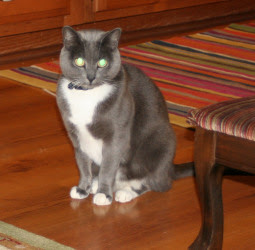 |
| ...a tuxedo cat |
For the origins of the word "tabby", click here.
For "marmalade", click here.
For "ginger", click here.
For another word derived from the name "Tom", click here.
For "calico", click here.
Please use the buttons in the left-hand column to share this post on facebook or twitter, or email the link to a friend.
You
can sign up to have your word of the week delivered directly to your
inbox here.
Subscribe to:
Posts (Atom)
About Me

- Katherine Barber
- Canada's Word Lady, Katherine Barber is an expert on the English language and a frequent guest on radio and television. She was Editor-in-Chief of the Canadian Oxford Dictionary. Her witty and informative talks on the stories behind our words are very popular. Contact her at wordlady.barber@gmail.com to book her for speaking engagements; she can tailor her talks to almost any subject. She is also available as an expert witness for lawsuits.